Saturday, 1 October 2022

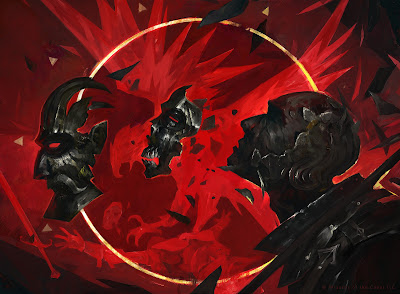
[GLOG] If Our Life Lacks Brimstone... (Class: Barbarian)

A class that eats rules to steal their strength for itself.

Class: Barbarian


"Berserker", art by Dominik Mayer

Starting equipment: Two-handed weapon of your choice, fur loincloth, warpaint in the 1d8th colour of the rainbow (black on an 8).
Starting skill: None (see below).

A: BARBARIAN!, Brute Force, Loincloth of Endurance
B: Rage
C: Eye of the Gods
D: Absolute Violence

A: BARBARIAN!
Erase your lowest ability score. Replace it with a BARBARIAN! score, which starts at 12. Each time you gain a Barbarian template after the first, gain +2 BARBARIAN! and erase your next lowest ability score other than BARBARIAN!.
You automatically fail any check against a stat you don't have.
You can substitute BARBARIAN! for whatever stat you'd normally use for a check if the task at hand is suitably BARBARIAN! - feats of physical strength and agility, mysterious foreign folklore, highly objectionable cooking, etcetera. (This is why you don't have a starting skill.)

A: Brute Force
You don't suffer non-proficiency penalties in melee. If you can hold it, you can kill with it. Any object you wield as a melee weapon deals 1d8 damage if you're wielding it in one hand, or 1d12 if you're two-handing it (so two-hand everything, obviously). Ranged weapons work normally for you, if you absolutely insist.

A: Loincloth of Endurance
As long as you wear no armour, you count as having the maximum possible hit points for each die you'd roll, and heal the maximum possible from lunch and a night's rest. If you don armour, like some kind of simpering continental, instead you have the minimum possible hit points. Shields don't count as armour to you and don't increase your Defence, but they count as weapons just like anything else you're holding.

B: Rage
Whenever you roll initiative or suffer damage, you can fly into a rage. While raging, you don't roll to hit - you just deal your damage automatically, and the target can make one attack back against you with the same rules (if it survives). You must attack every round if possible while raging, and can't exit your rage until the fight is over or an ally spends a whole round slapping some sense into you.

C: Eye of the Gods
Erase your Save value. You Save by flipping a coin. Heads succeeds.

D: Absolute Violence
When you roll initiative, you may also roll a single die of your choice and take that much damage, which can't be reduced by any means. If you survive this damage and your roll matches or beats the total number of HD of enemies in the fight, you black out for ten minutes and wake up drenched in the blood of your slaughtered foes. Ask your allies to tell you what happened, but don't expect coherent answers.

Friday, 16 September 2022

[OSR] Drinker-Folk - Bovar and Gnolls

When the world was young, two tribes sought greatness on the savannah.

The first tribe, the bovar, were born of Father Ox, peaceable yet stout and fell-handed, unmatched by any predator but crowded out by lesser grazers. The second tribe, the gnolls, were born of Mother Hyena, swift and cunning, but mere whelps against Lion and Serpent and Greatworm, the royalty of the plains.

One evening, the hottest of summer, the two tribes descended on the same watering hole. Normally, they would avoid battle, neither tribe thinking itself the other's equal, but their thirst was great and terrible, and all through the night they bit and gored and kicked and clawed one another to a standstill.

But, for all their many differences, the tribes shared the gift of speech and reason, the spark of sapience that eluded their peers. And, so the story goes, Father Ox and Mother Hyena sat down beside the still water, and talked, and found they had much to gain from one another. An accord was found. The bovar would champion the gnolls, protecting them and their kills from the attention of larger predators. And the gnolls would keep the bovar's rivals cowed and pruned, leaving them the best grazing-grounds to themselves.

Of course, ways changed over time, as the twin peoples learned to grow crops and tend livestock, but they never forgot their ancestral alliance. To this day, they are near inseparable. There is no "gnoll society" or "bovar society"; they can only be spoken of as one, as the drinker-folk. For, despite their vastly different diets, drink remains a great unifier, just as it was in the deep fog of prehistory.


Drinker-Folk Society

The drinker-folk settle near water, building sprawling city-states on lakes and across rivers, and surrounding them with rings of farmland and pasture tended by satellite villages. Their cities are airy and colourful, and smell amazing - to mute the scents of their meals, out of respect for their neighbours, the drinker-folk burn scented candles and incense everywhere they can. One notable quirk of drinker-folk architecture is its aversion to stairs, which are difficult to make equitable for both species - most buildings use ramps or hoists, if they have higher floors at all.

Drinker-folk masons work primarily in stone and ceramics. Wood is valuable and never used for construction, only for tools, alongside bone and tempered obsidian. Metal is a rarity, besides silver and copper currency.

Besides houses and places of business, the hub of drinker-folk society is the moot, a covered plaza that acts as a combination forum, marketplace, and taproom. Drinker-folk eat separately, but they drink together, and in great quantities. Besides water, their beer is legendary, and every moot will have its own house brew.

Drinker-folk government is oligarchic. Each city has two co-rulers, a bovar prince and a gnoll matriarch (these genders only vary in extreme circumstances). They do not maintain standing armies, but all adults train regularly as militia, and a handful of permanent officers organise them ad-hoc into patrols, regiments, or legions as necessary.

Gnolls outnumber bovar roughly two to one. Interspecies friendships and business partnerships are extremely common. Interspecies relationships are rare and considered somewhat unusual, though not taboo - there's a culture clash at play, since bovar are usually monogamous and gnolls are very much not.

Drinker-folk do have magical traditions, but their mages occupy themselves with farming, brewing, and crafts. Their attempts at combat magic have never proven any more effective than conventional methods.

Most pay some sort of vague reverence to Father Ox and Mother Hyena, their people's supposed progenitors, but they are not an especially pious people and have no organised priesthood.

As a general rule, drinker-folk are xenophilic, and they have peerless reputations for hospitality. Bovar tend to be sincere and considerate; gnolls aren't above good-natured ribbing and pranks. However, both species respond to any hint of hostility swiftly and decisively, and they're fiercely protective of one another, putting aside personal grudges and disagreements in an instant whenever their kin are threatened.


The Crunch


Leadership

Stolen from alex on the GLOG Discord.

Each group of bovar or gnolls will be led by a sergeant, usually identifiable by a fancier outfit (a cool hat is mandatory) and nicer weapons. The sergeant has an extra attack per round and gives the whole group +1 Morale. Test Morale when the sergeant dies. The values given in the profiles below do not include this Morale bonus.


Bovar

Bovar: HD 3, AC chain, Mv normal, Mr 7, Atk by weapon +1 die size, or fist 1d6. Brutal Charge.
Patrols of 1d3+1, or bands of 2d6, often paired with a similar gnoll unit.

Brutal Charge: Attacks a bovar makes after a solid, unimpeded run-up roll their damage die twice and take the better result.

***

Arms: Two-handed weapons. Sledgehammers are a particular favourite. Giant crossbows if they have to fight at range.

Look: Oxfolk. 9-10' tall, dark brown hide, cloven hooves. Men are slightly taller and have horns. Loincloths in earth tones, loose tabards for women, huge kite-shield-shaped hide pauldrons and thigh guards bearing pseudo-heraldic designs.

Manner: Deep, rumbling voices. At peace, terse but amiable, with a dry sense of humour. At war, stony and usually silent.

Tactics: Straightforward. Hold defensible positions, or advance slowly and then charge. Somewhat honourable by default, but they sink to the level of their opponents.


Gnolls

Gnoll: HD 1, AC leather, Mv normal, Mr 6, Atk by weapon, or bite 1d6. Harrier.
Packs of 1d6+2, or mobs of 4d6, often paired with a similar bovar unit.

Harrier: A flanking gnoll deals a minimum of 2 damage with attacks that hit, and 1 damage even if they miss.

***

Arms: Light hand weapons, often dual-wielding, or shortbows for ranged combat.

Look: Hyenafolk. 5' tall, mottled orange-brown fur, slightly hunchbacked. Women are more solidly built and have more pronounced fur patterns. Primary-colour piecemeal outfits, lots of straps and bone studs. Dyed patches and clan patterns shaved into exposed fur.

Manner: Sharp, glottal voices. Gregarious, talkative, and often crude, but respectful unless angered. Noisy in battle, alternating between guttural insults and that cackle.

Tactics: Ambushes, skirmishes, and psychological warfare. They outflank, surround, and isolate with brutal efficiency. Quick to retreat, but quick to rally, too.

If you want less threatening gnolls, they might also make a good Goon Squad.


1d6 Sights and Sounds in the Moots of the Drinker-Folk

1) A dozen gnoll youths accost and harass patrons at random. They're on a moot crawl, a popular rite of passage, but have run out of money, and promise they'll leave if someone buys them a round.

2) A flock of giant chickens (stats as dog) have escaped from a nearby butcher's shop and taken over the moot. They're confused, but not aggressive, and everyone steps around and over them and carries on as normal while the frantic butcher tries to recapture them.

3) A crowd has gathered around an elderly bovar couple and a pair of gnoll hustlers playing Savannah Morris (2v2, plays like the lovechild of chess and bridge). The bartender has abandoned her post to offer commentary for those at the back.

4) A few patrons have formed an impromptu jug band - a bovar sings a steady bassline while gnolls jam on items commandeered from a nearby ceramics vendor (who's a little miffed but trying not to cause a scene). Some "musical differences" have started to form between two of the drummers; a fight is not far off.

5) A crier recites the day's news, including a harrowing, completely inaccurate account of a border conflict not far from the city. Snorts, growls, warning cackles. Nobody is outright calling for war, but everyone is thinking it.

6) A candlemaker, wreathed in multicoloured vapour, hawks his wares. The smoke of certain candles has narcotic properties, controversial among more conservative drinker-folk; a couple such moralists are trying to argue the toss with the trader, but he's tuning them out.

Friday, 19 August 2022

d66 Oddball Hirelings, Clients, and Classes

This was initially my submission to a community project that doesn't seem to be going anywhere. Enjoy.

***

Each entry in the following this comes with the name and description of a (H)ireling, the (A)bility they possess, the (E)quipment they carry, and a (Q)uest they might offer.

As hirelings, they each cost twice as much as a standard 1HD guard or warrior, and bring all their listed equipment with them, plus whatever you give or loan them. They are combat-ready, but subject to morale like everyone else.

As quest clients, their rewards could include:

  • Normal quest reward stuff, like money and money-adjacent items.
  • The hireling joining you for free for a fixed term (or for a loot share rather than a salary).
  • The hireling teaching you their ability.

These entries double more generally as modular extra abilities for existing characters. Besides the quest reward option, they could be secret arts learned from lost tomes or bestowed by weird magic, or you could upgrade one into a full playable character by plugging it into the following special one-template GLOG class:

Class: Oddball
There's only one Oddball template. You can take it multiple times, but must make different choices each time.
Σ: Choose or roll a random entry on the Oddball Hirelings table. You gain the listed (A)bility, start with the listed (E)quipment if this is your first template, and gain a skill with the same name as the table entry. Then roll on your favourite random skill table for something you picked up to make ends meet, when your main gig wasn't working. Finally, choose a single ability from a thief-type class (a level 1 ability from one of Lexi's Thief Guilds, for example) for a little extra spice.

Enough preamble. Let's bring on the oddballs.

***

11. Acupressurist
H: Ephraim. Shabby and unkempt except for lacy white gloves. Rarely speaks above a whisper.
A: His touch attack can harmlessly purge a potion or toxin from the subject's body, if used within 1 round of ingestion / exposure.
E: Wooden massage rod (as club), finger strengthener, bottle of scented oil.
Q: He longs for renown. Help him save the life of someone important, as flashily and publicly as possible.

12. Anchoragent
H: Iulia. Eyes heavy with regrets. Tally marks on her sleeve, won't say what they're for.
A: Can lock or unlock a willing or helpless subject's joints individually with a touch.
E: Blackjack, jar of mysterious ointment, deed to a parcel of land on the other side of the world.
Q: Find and kill her old employer, who's living under a new identity somewhere nearby.

13. Ascertainer
H: Adarine. Robes adorned with geometric diagrams. Makes arcane gestures at empty air. Squints.
A: Can measure distances by eye and weights by feel instantly, to the nearest pound or quarter-inch. Counts things at 100x speed.
E: Geometry set including sharpened pair of compasses (as knife), weathered textbook, half a dozen IOU notes from various students.
Q: She was expelled from engineering college on a technicality the day before graduation. Get her the diploma she deserves.

14. Bureaumancer
H: Uhlvard. Lumbering, bespectacled sad sack with a voice you tune out almost reflexively.
A: Very weak telekinesis, only works on paper that's been written on. Detects spelling errors and bureaucratic mistakes with a glance.
E: Dog-shaped novelty paperweight (as club), quill and ink, spinning top, jar of strong coffee.
Q: Get him a date. A real one.

15. Breathmiser
H: Rajesh. Shaved head, huge beard. Wears dozens of talismans with the same fish symbol.
A: Can hold his breath for up to 30 minutes of physical activity or 2 hours of rest. Double these if he has 10 minutes to prepare.
E: Machete, stack of questionable spiritual pamphlets, large empty bucket.
Q: His evil twin Hejsar is stealing people's breath by strangling them, and blaming him. Exonerate Rajesh and stop Hejsar.

16. Censor-Witch
H: Zeg. Broad, balding, walrus moustache. Says "actually" and "technically" a lot.
A: Chooses a word each morning. When someone within a mile says the word, he hears it and sees their face and general surroundings in his mind.
E: Improbably heavy rubber stamp (as club), inkpads in black, blue, and red, bolt of silk (for gags) and tiny scissors.
Q: Get him a copy of The Desolation of Saint Judith, a recently banned heretical text. You know, for auditing purposes.

21. Contra-Chaplain
H: Sadia. Patchwork robe of religious vestments. Never ends a sentence without swearing.
A:
When she swills water in her mouth and spits it out, it affects the divine exactly as holy water affects the unholy.
E: Censer (as club), defaced holy book, bottle of absinthe, bottle of water, 25gp in unconvincing fake coins.
Q: Humiliate the church somehow, get arrested by church authorities for it, and escape.

22. Devil's Advocate
H: Xiangye. Tailored suit, tailored smile. One cigar a day. Blames everything on her ex-wife.
A: Can identify the exact terms of any supernatural contract, curse, or similar effect. 2-in-6 chance of finding a useful loophole.
E: Razor-tipped fountain pen (as knife), infernal legal textbook, case of fine cigars.
Q: Her case against a local demigod is running out of steam. Find or fabricate some evidence to revitalise it.

23. Disjecter
H: Queens. Tall. Shiny. All angles and edges. Beautiful in a harsh, inhospitable way.
A: Knows a 1-minute ritual to cut any object up to human size perfectly in half. She must be able to move and handle the object.
E: Sword, thrice-blessed whetstone, protractor, stick of charcoal.
Q: Deeply spiritual and humble, she fears her abilities. Find something - anything - she can't cut.

24. Dread Poet
H: Morgan. Too much eyeshadow. High-collared black trenchcoat, regardless of the season.
A: Recites the absolute worst slam poetry known to mortalkind. Protracted exposure deals damage equivalent to being on fire.
E: Reinforced steel quill (as knife) and ink, poetry notebook, makeup kit, poor-quality charcoal portrait of himself.
Q: Trick, bribe, or intimidate someone into booking him for a live show. He wants an audience of at least a thousand.

25. Faultsman
H: Howell. Hirsute. Talks very slowly. Taps random objects "to make sure they're sound".
A: Can identify when a machine is broken and what's wrong with it, purely by touch. No special acuity in fixing things.
E: Sharpened tuning fork (as knife), spectacles with adjustable lenses, bag of mints.
Q: The mints he carries are truly delicious, but out of production. Find a stash of them to keep him supplied - or, better still, the recipe.

26. Ferrobotanist
H: Tunde. A big, genial fellow in well-loved overalls. Thinks aloud. Mossy.
A: Can heal damaged metal with a 10-minute per inventory slot ritual, patching it with fibrous metallic growths. Up to 6 slots per day.
E: Many-times-repaired sword, gardener's gloves, pouch of high-quality bonemeal.
Q: He feuds bitterly with the smiths' guild. Find a problem they can't solve, but he can. Make one, if necessary.

31. Flingist
H: Jethro Southeast "The Beast" Cransley. Tattoos everywhere but his arms. Only answers to his full name, epithet included.
A: Can throw arrows as weapons - half damage, but +4 to hit. With at least a minute to prepare, hits automatically.
E: Quiver of 20 arrows, spectacles, capelet, collection of impressive but worthless medals.
Q: He suspects his archrival Serafine of doping. Expose her, or get Jethro some stronger drugs.

32. Handler
H: Crowe. Goggles, face mask, heavy boots. Terse but polite. Clean freak, where possible.
A: The skin from her elbows to her fingertips is impervious to contact hazards.
E: Brass knuckles, 3 blocks of lye soap, vial of litmus.
Q: Give her a tactile sensation she's never felt before. (She's pretty jaded. Be creative.)

33. Hound-Blessed
H: Afwen. Jowly, with big, doleful eyes. Patchy red skin rash. Sheds.
A: Acute, discerning sense of smell. Can track scents like a bloodhound.
E: Hand axe, collar and leash, jar of homemade pickling solution.
Q: Treat or cure her allergy to herself. It's the only way to clear up that rash.

34. Jeermonger
H: Rex. Clean and well-dressed. Always nursing a black eye or cauliflower ear.
A: Knows insults and taunts in every language, even those he hasn't encountered yet - he just gets a feel for them.
E: Knife, set of cooking pots, bottle of tequila, makeup kit.
Q: He seeks a challenge. Find him a worthy opponent for the roast-off of the century.

35. Levermaester
H: Mabh. Slight and frail-looking, but stronger than you think. Permanent cryptic smirk.
A: Counts as two people in matters of pushing, pulling, and lifting. Up to three people working with her also have their efforts doubled.
E: 4 crowbars, book of log tables, abacus, enormous black clay pipe.
Q: Deliver this thank-you note to her mentor, who died twenty years ago.

36. Lockstiff
H: Ash. Hunched and gangly, like a marionette. Constantly asks if you're really, absolutely sure.
A: Can render any lock or lock-like object unopenable with a minute's work.
E: Knife, lockpicks (which he can't use), thick leather gloves, tinderbox.
Q: Find a reliable method for undoing his work - currently, he doesn't know of one.

41. Mime-Maker
H: Helena. "Shirt" is just stripes of overapplied black and white grease paint. Hates reptiles.
A: Anything she touches with both palms is completely silent as long as she maintains contact.
E: Knife, 2 pots of grease paint, ball gag, umbrella.
Q: Persuade her crush, a novice bard, to renounce his ways so that they can be together.

42. Moonshiner
H: Egg. Hunched, paunchy, needle-sharp teeth. Possibly an unusually clean, smart goblin.
A: Can turn the fluids from a fresh human-sized corpse into a bottle's worth of high-proof, worryingly tasty moonshine. Takes 1 hour.
E: Broken bottle (as knife), 6 unbroken bottles, jar of pickled bugs, 5' reacher-grabber.
Q: Help him replicate the best batch he's ever made, which came from the corpse of a priest.

43. Multi-Druid
H: Barnabas. Shiftiest guy you've ever seen. Jumpy, sleep-deprived, chews paper like gum.
A: Transforms at will into two raccoons. They act independently but can't be more than 30' apart. If one dies, both do.
E: Shillelagh (as club but fancier), 3 vials of powerful insecticide, preserved dead songbird in paper bag.
Q: Stop the city's vermin cull, by any means necessary.

44. Muscarist
H: Yalic.
Cheerful, sweaty. Carries a buzzing, gauze-topped clay jar like a briefcase.
A: Can speak with flies. They can advise on the severity of wounds, the edibility of meat, and other matters of bare flesh.
E: Swatter (as club), jar of flies, jar of honey, jar of vinegar, fishing rod.
Q: His flies are refusing to work, demanding to be taken to their "new king". Find it and pacify, subjugate, or exterminate it.

45. Noise Bard
H: Cantwell. Portly and jolly. Loud, rhythmic breathing. Tuning forks sewn into his clothes.
A: If you can hear him humming, it takes a Save vs. magic, which you can fail on purpose, to hear anything else.
E: Sharpened tuning fork (as knife), harmonica, jar of extremely flammable skin moisturizer.
Q: His noble lover considers him uncouth and won't be seen with him in public. My Fair Lady him to help him win her heart.

46. Pseudowizard
H: Sunny. Blue-tinted skin. Fidgety. Plays obscure card games against herself in her spare time.
A: 1MD. Doesn't know any spells, nor can she learn them. Detects as a 4MD archmage.
E: Fancy staff, pointy hat, dictionary relabelled "SPELBOKE", 5 decks of variant playing cards.
Q: Get her out from under her crushing student loans.

51. Pyrotechnician
H: Giles. Bleached spiky hair, red-tinted spectacles. Leaning a bit too hard into the "mad scientist" act.
A: Can breathe and manipulate gouts of harmless but extremely realistic fire.
E: Poker (as club), tub of hair wax, bag of soot, dry-ice smoke bomb.
Q: Find a way for him to use real pyromancy, despite his magically inert brain and terrible attention span.

52. Refiner
H: Bootblack. Haggard, gnarled, dressed in rags. Laughs at nothing, doesn't laugh at anything else.
A: With constant attention, she can make one outfit at a time look like a conscious, expensive, and dangerous fashion statement.
E: Scissors (as knife), full seamstress kit, 3 silver hand mirrors.
Q: Her current project needs one last ingredient - a single square yard of wizardskin.

53. Serpentine
H: Slide. Absurdly swollen pecs. Top-heavy. Face looks like it's been ironed flat.
A: Can crawl flat on their belly as fast as they can run.
E: Knife, safety goggles, mechanical tinderbox, tub of mysterious grease.
Q: Get them a pet snake. Something small and lethally venomous, please.

54. Shoveller
H: Baldwin. Smells of wood polish. Won't shut up about "the war", but never specifies which war.
A: Can do anything with a shovel three times faster than a normal person. In his hands, a shovel counts as a battleaxe.
E: Weathered shovel, shiny spare shovel, 30' coil of fuse cord, pet mouse in cage.
Q: He buried the last of his war pay in a disused sapper's tunnel somewhere - dig it up and he'll split the loot.

55. Slime Host
H: Leigh. Massive beehive hairdo. Moist. Never more than half awake.
A: A pet slime lives in her hair. Its acid is too slow to be useful in combat, but can dissolve anything that fits inside it over 24 hours.
E: Scissors (as knife), jar of hair wax, bottle of decent wine, 3 acid-stained romance novels.
Q: Her slime is about to mitose, and has grown far more aggressive and acidic. Find a safe place to contain it until it spawns.

56. Stashkeeper
H: Winters. Outfit made entirely of pockets. Usually has at least one cut or bruise he hasn't noticed.
A: If you need multiples of an item and you're one short, there's a 5-in-6 chance he has the last one you need stashed on his person.
E: Claw hammer, thurible, prism, skin-scraper, pad of litmus paper.
Q: Prove your thrift by getting him an extra copy of each of his starting items - without paying for any of them.

61. Steeplejack
H: Jo Gables. Tiny, taut frame. Hands are a mess of scars and calluses. Attracts pigeons.
A: As long as it's physically possible, she never falls, trips, or stumbles unless she means to.
E: Climbing pick, 50' coil of rope, pocket watch, 3 carabiner clips.
Q: Get her ban from church rooftops rescinded by winning over the local gargoyle population.

62. Swallower
H: Odwin. Tall and skinny. Exceptionally straight back. Pained, scratchy voice.
A: Can safely swallow any solid object that fits down his throat, and retrieve it at will with minimal mess.
E: Steak knife, 3 bottles of olive oil, hand drill, hand-cranked circular saw.
Q: He swallowed a live squid which he can't retrieve. It's biting him from the inside. Kill or placate it without hurting him.

63. Thread Whisperer
H: Tall Saul. 102 years old. Speaks a strange, phlegmy dialect. Sleeps standing up.
A: Can hold a piece of rope, string, or cord up to his ear and sense anything it hears, smells, or feels anywhere along its length.
E: Shears (as knife), 50' ball of string, brass ear-trumpet, brick of adhesive putty.
Q: He wants his pension pot, but the bank won't let him have it until he retires, which he refuses to do. Retrieve it.

64. Traplomat
H: Philemon. Thinning hair. Steel jewellery painted gold. Calls everyone "friend".
A: Can parley telepathically with traps. They respond well to promises of maintenance, resupply, or interesting victims.
E: Pliers (as club), collapsible 15' pole, 30' roll of bondage tape (sticks only to itself), bottle of mechanical grease.
Q: Bring him an intact, functional example of an exotic trap he's never seen before. He's lonely.

65. Unarchitect
H: Lexanne. Tiny, grinning ball of anarchy in a piecemeal boilersuit. Hisses like a cat.
A: Can discern the weakest point of any structure and whether any given attack or demolition will be enough to break it.
E: Sledgehammer, 3 steel spikes, thumb-sized vial of thermite.
Q: Get her off the hook for the string of vandalisms she definitely did commit over the past few weeks.

66. Witness
H: False Rebecca. Aquiline features. Stutters. Mismatched eyes - one brown, one grey.
A: Closing or covering one of her eyes stores a perfect photographic memory of whatever it was looking at until she opens it.
E: Knife, sketchbook and pencil, 2 eyepatches, hand bell.
Q: Expose the fraudulent author who's selling her memories as successful fiction. She'd settle for a cut of the profits, though.

Tuesday, 16 August 2022

Final Fantasy XIV and the Joy of Rigidity

Final Fantasy XIV is new ground for me in several respects - it's my first MMO, my first Final Fantasy game, and the first time I've ever seen a game character use the word "forsooth" and taken it vaguely seriously. At the time of writing, I have almost finished the main story questline of the game's first expansion, Heavensward, and my playtime clocks in around 140 hours.

My main class at the moment is Dark Knight, a heavily armoured tank with a two-handed sword (each class in FFXIV is defined by the type of weapon it uses). As I levelled up, I unlocked a fixed set of abilities in a fixed order - some were gained purely through levelling, others through story quests, but at no point did I choose between sub-paths or assign points to a skill tree. Even my choice of race didn't really affect my abilities; there are minor stat differences between the races of Eorzea, but these differences are small enough that they become irrelevant at higher levels. Steady Night is a hulking, muscular roegadyn, but he could be a diminutive lalafell and nothing would really change about his performance or playstyle.

Now, this isn't as limiting as it might seem. Remember how classes are defined by the weapons they wield? Well, all I have to do is give Steady Night a gun, and he'll switch class to Machinist, a hard-hitting ranged DPS. This easy class-switch ability is one of FFXIV's most touted features, eliminating the need to create multiple "alt" characters to play as multiple classes (and going hand in hand with race choice having almost no effect on class performance). But, as a Machinist, Steady will have the same linear ability progression as any other Machinist. And every other class works the same way.*


Crafting and gathering skills in FFXIV are assigned to their own special noncombat classes. I've also been levelling Steady as a Miner; it's a great downtime activity to keep my hands busy while I listen to an audiobook or hang out on Discord with my partner.

I'm not really building a character - it's more like I'm selecting a prebuilt kit off the shelf, and, if I want something different, I pick a whole different kit rather than modifying this one. This is quite rare in MMOs. It's much more common for classes to have multiple specialisation options, and often there are race-specific abilities, extra skills from particular pieces of equipment, or class-agnostic extras unlocked through some means other than levelling. In theory, there are many different ways to build any given class. There's none of that here.

As an inveterate tinkerer and lifelong fan of "builds" in games, I was expecting to hate this. But I don't. I think I love it, actually.

From a development standpoint, the most obvious advantage of FFXIV's approach is that it makes balancing a lot easier, and my understanding is that the game is generally considered to have pretty good class balance. There is of course a metagame and a rough hierarchy of power, but every video I've watched on the matter, even those aimed at high-end raiding and similar hardcore content, has stressed that no class is completely non-viable. This stands in stark contrast to games like WoW, where certain specs or entire classes often end up being too strong or unuseably weak for a period of time. In extreme cases, the end result can wind up being basically the same as FFXIV's setup, but with the good builds floating in a sea of trap options.

But, as a player, I have also found the lack of choices in character building strangely liberating. I don't need to look up guides on optimal buildcraft, or stress over hunting down specific items with the skills I need. I don't feel like I'm missing out by passing up a cool-looking option in favour of a mathematically correct one. I don't have to worry about being booted from a pick-up group for a suboptimal build; if I keep my gear up to date with my current level on its simple, linear scale, my character is properly equipped and ready to roll. And, in a sense, it keeps me honest. If I die in a dungeon or fail a boss fight, I can't blame it on having a bad build - I have to take responsibility myself. (Or blame the healer, but I've been lucky enough to have pretty good healers most of the time. Except that one White Mage the other day who kept pulling. Not sure what his deal was.)

What I find interesting about FFXIV's approach to class design is that it stands in opposition not only to the wider MMO sphere, but to a trend in games in general. Buildcraft is very much en vogue at the moment, at all levels of game development. At the top end, you have triple-A juggernauts in the mould of Destiny, building themselves around abundant loot and build diversity, to varying degrees of success - the live-service "looter" genre seems to be cursed with terrible launch states, from Anthem to Marvel's Avengers. Indie developers, meanwhile, have seized upon roguelite elements as a kind of secret sauce to brighten up any genre, encouraging players to craft new builds for each run and unlock more options for the next one. And, of course, there's the deckbuilding boom, with collectible card game elements grafted onto everything as developers scramble for a slice of Slay the Spire's pie. Every game seems to ask you to dive into its ocean of options and put together your character, your deck, your arsenal, your experience.

I thought I wanted this. I've always been drawn to the concept of infinite possibilities, of being able to customise my character just so. My previous game obsession, Warframe, snared me with promises of building my frames and weapons in countless fun, overpowered configurations, wrapped in a kitchen-sink space opera setting with a vast iceberg of lore, and... I mean, I did have fun! Warframe's moment-to-moment gameplay loop is really good! But the currents on that ocean of options dragged me in too many different directions, and I found myself losing focus and drifting away. Granted, there were other things about Warframe that frustrated me, chiefly the state of its grind and economy and a frustrating array of disconnected, underdeveloped subsystems, but I do think choice paralysis was a real factor in my losing interest in it.

Final Fantasy XIV's gameplay is much less fluid and dynamic than Warframe's. It's an old-world game in many senses - old-world control scheme, old-world combat system, even an old-world pricing model. The pacing is more sedate, and my character's powers far more restrained. Steady Night's basic 1-2-3 attack combo is never going to break the game's balancing wide open through six carefully selected perks. FFXIV calls its classes "jobs", and that actually feels very apposite: I have a job to do, with a clear job description and the right tools to perform it properly. All I have to do is use them right, and within that goal are so many interesting choices - when to move, where to use abilities, how to deal with a boss's special attacks - that I don't think I need any more of them.


* Technically, there's one class, Blue Mage, with a lot of choices involved. Its gimmick is that it copies abilities from enemies, so it can pick a subset of skills from a gradually growing spellbook. However, Blue Mages are considered separate from the game's "core" classes, and they're not allowed in standard instances, mostly relegated to their own class-specific content. It's best to think of Blue Mage as an elaborate minigame rather than a proper class.

Wednesday, 29 June 2022

Thoughts about Love, Death & Robots, Season 1

I watched the first season of Love, Death & Robots end to end in a single day recently. Here are some thoughts about it. (I wouldn't call them anything so grandiose as a review.) Spoilers throughout, and, much like the series itself, this is probably NSFW and carries a content warning for sexual violence (discussed but not depicted). For those unfamiliar, I've included capsule summaries of each episodes in italics.

Saturday, 11 June 2022

[OSR] Ogres, Four Ways

Between zero and four of the following accounts are true.


"Gruul Spellbreaker", art by Zoltan Boros

Monday, 6 June 2022

[OSR] A Visit from the Goon Squad

Discussion on Discord recently alighted on the topic of low-HD minion types, and, more specifically, campy cinematic goons, inspired by Power Rangers and its endless supply of thematically diverse grunts. I've also been reading through the draft docs for Skerples' Monster Overhaul, and one of the things that's really impressed me about it is how many bits of inspiration it offers for repurposing and reskinning one statblock with minor variations.

Between those two things, I felt like writing up some goons. I'll be borrowing a couple of tricks (read: shamelessly nabbing stuff) from this Goblin Punch post.

(The title is from Jennifer Egan's novel of the same name, which I highly recommend).


"Earwig Squad", art by Warren Mahy


[Fluff] Quarter-Hour of Writing Challenge: Laws and Customs

A challenge by Library of Attnam, discovered via Archons March On.

This post is brought to you by PG Tips tea. PG Tips: It's What They Had At The Shop.


"Azor's Elocutors", art by Johannes Voss

Thursday, 2 June 2022

[GLOG] Dead Century, a GLOG (Unfinished Stream of Consciousness Edition)

Dead Century is a setting I've been mucking about with for a long while. It's set 50 years after a magical zombie apocalypse called the Spasm, in the ruins of a world fought over by squabbling arch-necromancers, with a few pockets of human resistance flying under the radar, beneath notice compared to the grand schemes of the dead. I guess I'd call it "grimbright" - shit's bad, but there's hope for change, and the human spirit has persisted.

I've wanted to make a GLOG out of Dead Century for ages. Today, as we "celebrate" 70 years of the corpse-queen's impotent reign over this wretched isle, it felt appropriate to try and hammer some of it into shape, neatness be damned. So, in the hope of breaking my creative block and maybe harnessing the momentum to do some more work on OLOG, here are the beginnings of a system, I guess. Concrit very welcome. Here's a pretty picture; there's naught but rules under the cut.

"Crowded Crypt", art by Jarel Threat

Friday, 14 January 2022

[GLOG?] Pain

I've been doing a lot of design by subtraction recently. OLOG's main mechanical trick is that it does away with variable ability scores - there are still some calculated stats like Defence and Save values, but instead of Strength, Intelligence, Tastiness etc., you have Virtues.

What else can I tear apart and rework? I put most of this together on my lunch break. (This isn't going into OLOG, I just wanted to get the thoughts down.)

Pain

Hit points are gone. Damage rolls are gone. Replace them with Pain.

Pain is real, tangible harm, like getting hit with a weapon, fireball, or death curse. Lesser injuries might hurt or inconvenience you, but are not classed as Pain.

Creatures have a pain threshold (T). 1 is puny, 5 is hardy. Most humans have an innate Threshold of 3.

When you suffer Pain, roll a d6. If it exceeds your Threshold, you die.


art by Dominik Mayer 

If you'd rather not risk death every time you get hit, you big dirty coward, there are ways to protect yourself.

Wards

A Ward is something that can save you from Pain - think of it as sacrificial armour, something you can wager instead of your life. Here are a few things that serve as Wards:

  • A sturdy shield (an item).
  • A blessing of health (a buff).
  • A barricade to hide behind (an environmental element).
  • Your personal grit (a character ability).

Whenever you suffer Pain, you may invoke a Ward to change the stakes of the die roll. Instead of wagering your life, you wager the integrity of the Ward, and roll against its threshold rather than your own. If the d6 breaks the threshold, the blow is still absorbed, but the Ward is disabled and can't be used again, though it may recharge if some condition is met.

  • The shield breaks. It can probably be repaired.
  • The blessing wears off. It won't come back unless your party's priest casts it again.
  • The barricade cracks and crumbles. You could rebuild it, but you'd be starting from scratch.
  • Fatigue and stress set in and dull your grit, but you'll get it back as soon as you have a minute to rest.

Most Wards are not universal - there will be some sources of Pain against which they can't be invoked.

  • The shield won't help you against area attacks, or threats you don't see coming.
  • The blessing only wards you against mundane harm - magical attacks bypass it.
  • The barricade naturally only works against things coming from the other side of it.
  • Grit is a special case. We'll say this one is universal.

Other Considerations

Attack rolls and Defence are still assumed to be a thing.

Without variable damage dice, we need a new way to handle weapon power. Particularly powerful weapons could be represented in a few ways - powerful attacks could have a penetration value that reduces the threshold of physical Wards invoked against them. With this in mind, Wards could well have thresholds higher than 5. These Wards never fail under normal conditions - you'll need a penetrative weapon to break them.

Especially nasty attacks, like dragon breath and killing curses, could potentially cause multiple rolls' worth of Pain, either to single targets or spread out across a group. You can't use the same Ward more than once against the same attack.

I'm still not sure how to handle body armour. It could be a simple Defence buff, but that feels against the spirit of the system. It could be its own Ward, but having a whole suit of armour fall apart to a single decisive hit feels silly; I considered armour having a degrading threshold (it gets worse as you take more hits) but that's a bit too fiddly for my tastes. My current, provisional ruling is that armour increases your personal threshold, but is subject to being partially or fully ignored by penetrating weapons - maybe it's like

  • Unarmoured: T3
  • Leather: T4
  • Chain: T5 - you can get through with a non-penetrating weapon, but it's going to be tricky
  • Plate: T6 - penetrating weapons needed to do any harm

Nonlethal attacks work the same as lethal ones, but the failure condition is "you're unconscious" or similar rather than "you die".

Instead of dealing extra damage, critical hits bypass almost all Wards.

You might also be able to attack some Wards directly if you want them gone. If successful, this forces a roll against that Ward, rather than the target getting to choose.

Pain in Action

The anti-priest Arlene, hastening home to her safehouse, feels her heart sink as hoofbeats echo behind her. An errant Stag-Knight is tailing her, no doubt seeking the bounty on her head.

Arlene has:

  • Personal T4, including a +1 bonus for her leathers.
  • Grit (T2), as she's not really a fighter.

The Stag-Knight has:

  • Personal T5, including a +2 bonus for his chainmail.
  • Grit (T4), he's an experienced warrior.
  • A shield (T3).

As a straight fight, this isn't looking good for Arlene; her magic is almost spent, and she doesn't have a weapon powerful enough to be of use against chainmail. She'll need to be smart to have a chance of survival.

Arlene turns on her heel and draws her bow, taking a potshot at the approaching Stag-Knight. The arrow finds its mark, so now the Stag-Knight faces Pain. He chooses to invoke his shield, rolls a d6, and gets a 3, not enough to break his shield's threshold of 3. The arrow buries itself deep in the wooden board, but the shield holds

The Stag-Knight dismounts as he reaches Arlene and draws his sword, ready to cut down the infidel before him. His swing connects, so now it's Arlene's turn to face Pain. She invokes her meagre grit, figuring she'll need as many extra chances against this foe as she can get, and rolls a 3, enough to break her grit threshold. She ducks beneath his hopeful high swing, but it's close.

With her grit disabled, Arlene has no Wards left, and any blows that land on her now will be potentially deadly. She drops her bow and makes a show of drawing a blade of her own, teeth gritted in desperation. The Stag-Knight watches her sword arm with fierce focus, and doesn't catch the subtle swell of violet-edged darkness coiling around her other hand.

She slams her left hand into the Stag-Knight's flank. Castigate is a potent curse, inflicting two separate Pains. The Stag-Knight wasn't expecting this attack, so he can't invoke his shield again; he invokes his grit against one Pain, but can't use the same Ward twice against a single attack, so he has no choice but to suffer the other directly to his body.

He resolves the first Pain against his grit, and rolls a successful 2, but it doesn't matter. The second, resolved against his body, rolls an unlucky 6. The sweet, calculated words of Him Below flow through the Stag-Knight's body like molten iron, and he collapses, steaming, to the ground.

Arlene catches her breath and retrieves her bow. Having had a moment to recover, her grit recharges - should she get into another fight, she'll be able to use it again. But no amount of grit can protect her from her patron. The castigate that felled the Stag-Knight used more of His power than she's earned, and the accountants Beneath never sleep.

But Why, Though?

It makes combat scarier, and gives me interesting dials to turn, to make characters tougher in different ways. Heavy armour, hard-won fighting experience, and magical protection can all impact a character's toughness, and they can do so in different ways (increased personal threshold, increased grit, and a whole separate Ward, respectively).

It is also badly in need of refinement and testing, but getting the ideas out early can't hurt!

Friday, 7 January 2022

[OSR General] AI-Generated Monsters

Reddit user Deep_Fold trained an AI on D&D monsters and produced some fun images. Phlox challenged some of the gretchlings that coalesce and fester on his Discord server to put stats to them. This is me doing that.

Chlorophore

Solitary, nocturnal jungle ambush predator. Sometimes attempts to disguise itself as a leaf, but, since it's the size of a horse, this doesn't work. Fortunately, it has other means of stealth.

HD: 4
AC: as chain
Move: normal
Morale: 6
Intelligence: stupid dog, practiced but predictable
Speech: wet reptilian grunting
Damage: tendril 1d8 / tendril 1d8 (odd rolls are acid damage, even rolls are bludgeoning); or blinding flash (see below)
# Enc.: solitary

Light-Snuffing Aura: Mundane light sources within 30' of the chlorophore are snuffed. Natural or magical sources are suppressed. The chlorophore can turn this aura on and off at will.

Blinding Flash: Used instead of an attack. The chlorophore releases stored light in a hot bright wave. Everyone in a 60' radius must Save or be blinded. If you fail two consecutive Saves, it's permanent. The chlorophore must snuff five torches or lanterns, or spend a day sleeping in direct sunlight, to recharge this ability.

If harvested within an hour of death while charged, a chlorophore's light glands can be used as flash grenades, or sold for 10gp apiece to a sufficiently sketchy alchemist.

Tragedian

Wise librarians know it's bad luck to shelve too many sad stories, especially true ones, in close proximity. Only the very wisest librarians know why. Tragedians are creatures of ink and sorrow, crawling off the page to drown the world in misery and melodrama.

HD: 1
AC: as leather
Move: normal
Morale: 10
Intelligence: florid and articulate but wholly irrational
Speech: half-coherent babbling about various horrible things (use this post for inspiration)
Damage: draining touch 1d6-3 plus misery (see below)
# Enc.: moan of 1d4+2 or lamentation of 2d6

Misery: If a tragedian's draining touch rolls net 0 damage or less, it instead inflicts 1 point of misery. If the target already has 5 or more points, instead it's 1d3 Wisdom damage.
Apply your current misery as a penalty to all d20 rolls. Whenever you fail a roll that you would have succeeded on if not for your misery, Save or spend the next round doing nothing but wailing, sobbing, and lamenting your failures.
Receiving a vigorous pep-talk in a safe place from someone with no misery, which takes at least a minute, removes all your misery.

Tragedian bodies contain about a pint each of useable ink. Writing with tragedian ink is said to improve your command of language.

Shard Puppet

An undead hybrid creature made from cursed permafrost and the blood of a hypothermia victim. Cold Artists use shard puppets as guards and enforcers. The wicked fever they can bestow is often considered a fate worse than death; they do not hand it out wantonly, but won't hesitate to make examples if their masters' edicts are disrespected.

HD: 8
AC: as chain; half damage from slashing and piercing weapons
Move: normal, fly normal
Morale: 9
Intelligence: mostly obedient servants, but just enough initiative to keep you guessing
Speech: low telepathic growl
Damage: claw 1d8 / claw 1d8; or blood feed (special, see below)
# Enc: solitary or troop of 1d3+3

Edge Fever: Anyone who ingests shard puppet blood contracts edge fever. Whenever you critically fail a melee attack roll against a shard puppet, Save; if you fail, some of its blood got in your mouth, and you now have edge fever. A shard puppet can also use its attack action against a restrained target to force-feed them blood, in which case they also get a Save.
Edge fever's symptoms are a slightly raised temperature, mild lethargy, and automatically failing all Saves. Swallowing a lump of hot coal (1d6 damage) suppresses edge fever for a week, but there's no known mundane cure. It's part disease, part curse, so curing it with magic is tricky too. If a reliable, replicable antidote for edge fever were found, its value would be incalculable, but it would doubtless draw the attention and hostility of the Cold Artists.

Antaviran Inquirer

Antaviran Inquirers are extradimensional grad students completing the final trial of the Debate and Diplomacy Department. They must satisfy their voracious appetites with local sapient beings for the duration of their study / exile, but must also grant any victim a chance to make an argument for why they shouldn't be eaten.

HD: 6
AC: as plate
Move: levitate (1-3' above ground) normal
Morale: 7
Intelligence: theoretically sharp, practically hazy
Speech: "well, actually"
Damage: 1d3 claw / 1d3 claw or swallow (see below)
# Enc.: solitary or pair

Swallow: When an Antaviran Inquirer hits with a claw attack, it latches onto the target with that claw. A character can forfeit their move or attack for the round and attempt a Strength or Dexterity check to unlatch a claw.
An Inquirer can replace one of its attacks against a character latched with both claws with a swallow. No attack roll - the Inquirer splits open down the middle and the target must Save or be encased within. 1d8 acid damage per round as long as the Inquirer lives. It's possible to pry the case open with a crowbar, or persuade the Inquirer to release the target voluntarily.

Inquirers won't eat anyone who can present a compelling moral, philosophical, or logical case for why they specifically shouldn't be eaten - general arguments against eating sapient beings do not apply. Feel free to roleplay this, or use opposed Intelligence checks (roll 1d6+11 for the Inquirer's Int).

Thursday, 6 January 2022

[OLOG] Combat and Pressure

Special thanks to If Our Lives Be Short for inspiring me to get this written up properly.

Initiative

PCs roll for initiative (d20+level, possibly modified by Virtues). NPCs have static initiative values and don't roll. Initiative counts last for the whole fight unless someone does something to change them.

Actions and Pressure

Under normal circumstances, you get two actions per turn. You cannot usually take the same action twice.

If you are within reach of a creature that wishes you ill, you are under pressure. While under pressure, when you take an action, your turn ends afterwards unless you announce as you take the action (and before making relevant rolls) that you're pressing on.

When you press on, you suffer automatic damage. The die you roll for pressure damage is equal to half of the largest damage die among creatures threatening you - if one of them has multiple attacks, only take the largest. This roll has a minimum result equal to the number of creatures threatening you, which can exceed the normal maximum roll. Flat bonuses to damage rolls don't apply to pressure unless otherwise stated.

Some examples:

  • Threatened by two orcs with 1d8 swords: You take 1d4 damage, minimum 2.
  • Threatened by a badlands superpredator with a 1d10 bite and two 1d6 claws: You take 1d5 damage.
  • Threatened by eight humans with 1d6 knives: You take 8 damage. You probably should not let this happen.

If it matters, pressure damage happens simultaneously with the the action that triggered it.

Some actions have one of the following tags, which affect how they interact with this system.

  • Extended actions consume both your actions for the turn. If you're under pressure, you must press on to use an extended action.
  • Free actions don't consume an action and do not trigger pressure.

List of Combat Actions

Not exhaustive.

  • Move. Combat distances in OLOG are mostly abstracted - one move action is enough to move you about 30ft, or one distance band towards or away from a group of enemies.
  • Attack. Most characters get only one attack per action, but some combat-focused classes can make more, usually with a condition attached. If you get multiple attacks per action, you can break them up with your other action if you like - so you can, for example, make one attack and then move before making your second.
  • Defend yourself. +2 to AC until your next turn, or +4 if you're holding a shield.
  • Cast a spell. Extended action.
  • Retrieve an item from your pack, or switch one you're holding with one in your pack. This is a free action for the topmost item in your inventory, and an extended action for one in the bottom half of your inventory.
  • Strategise. Adjust your initiative count by 1d6 in the direction of your choice. Takes effect next round.

Monday, 27 December 2021

[OLOG] The Orc Armoury

Lore TBA, but basically orcs have different weapons from humans, especially melee weapons, and they tend to be rather specialised. Bones are orc currency (not actual bones, domino-shaped coins with holes in them, often braided together on strings for convenience). 1 bone = 1sp for conversion purposes.

Fortes

Most weapons have a forte (F:) listed. If the condition for a weapon's forte is met, roll a d12 in addition to the normal damage die and take whichever result is higher.

Lesser Weapons

1d6 damage, 1 slot. Require one hand.

  • Improvised weapons are considered lesser weapons, but do not have a forte, and may require more than one hand depending on their nature.
  • Unarmed attacks count as lesser weapons with no forte, and can't deal damage to an alert, steady opponent - you'll need to stun them, knock them down, or catch them unawares to get that damage in. Consider a manoeuvre instead. (More on those in a future post.)

There's only one lesser weapon you can actually buy. A decent knife costs 5 bones; paying more will get you a prettier one.

  • Knife - Orcish knives are usually big, heavy, and utilitarian. Not balanced for throwing.
    F: Your target is not expecting combat or malice.

One-Handed Weapons

1d8 damage, 1 slot. Require your dominant hand (you can effectively carry a shield or lesser weapon in your off-hand, or leave it free for other purposes). 50 bones each.

  1. Arc-Sword - A scimitar with most of its weight concentrated towards the sharply curved centre of the blade.
    F: You moved into engagement with the target this round.
  2. Boarding Axe - A favourite of marines - an axe with a sturdy spike set into the back of the shaft.
    F: Your target is not on stable footing.
  3. Butchermaul - A wicked axe-mace, with multiple blades and crushing heads to hew, hack, and rend.
    F: Your target has a bestial body plan.
  4. Cull-Knife - This huge triangular knife has serrated edges and a reinforced, needle-sharp tip.
    F: You are not under pressure.
  5. Mace - Any one of dozens of variations on the theme of "injurious weight on a stick".
    F: Your target is unarmed.
  6. Shredding Axe - This axe has serrated teeth at its head, spread in multiple directions like barbed wire.
    F: Your target is at half hit points or less.
  7. Squaresword - A thick, heavy sword with a hard right angle at the tip and a well-honed chopping edge.
    F: Your target has an orcoid body plan.
  8. Straightsword - This sturdy broadsword demonstrates refinement or arrogance, depending on who you ask.
    F: Your target is not engaged with anyone but you.
  9. Strife Axe - Ubiquitous in any orc military, this simple axe has a distinctive, slightly forked head.
    F: Your target is wielding a manufactured melee weapon.
  10. Wedge Hammer - The head of this short warhammer is set with a wedge to concentrate its crushing strength.
    F: Your target is significantly smaller than you.

Two-Handed Weapons

1d10 damage, 2 slots. Require both hands. 100 bones each.

  1. Coroner's Coil - A length of razor-edged chain between two handles, like a deadly skipping rope.
    F: Your target is animate but not alive.
  2. Felling Spike - A spear with its head bent at a slight angle; some models have hooked heads.
    F: Your target is mounted.
  3. Harvest Sword - Traditionally, this greatsword has seven teeth placed asymmetrically along its twin edges.
    F: Your target has 2HD or less.
  4. Hawk's Talon - Many variants exist of this hooked fork - the Hawk's Talon has three tines and a ripping spike.
    F: You are flanking your target.
  5. Meat Hammer - This hammer's broad, spiked head is too heavy to swing in any direction but down.
    F: Your target's movement is restricted.
  6. Scour-Axe - Three narrow heads top the shaft of this poleaxe, ideal for punching through hide or metal.
    F: Your target is wearing manufactured armour.
  7. Skewer - This barbed harpoon has a weighted head and twisting blades running along its front third.
    F: Your target is at least twice your size.
  8. Soulcatcher - A hooked claw on a stick, reputed to be able to drag the soul right out of one's body.
    F: Your target has cast a spell or used a magical ability this combat.
  9. Wailer - Takes its name from the awful whistling noise of air passing through the heavy, ventilated axehead.
    F: Your target is not combat-trained.
  10. War Sun - This polearm's vicious circular blade is spun by a clever system of weights when the weapon is swung.
    F: Your target is unarmoured.

Ranged Weapons

Orcs tend to view ranged combat as unglamorous but necessary - fighting at range isn't craven or dishonourable, but it's strictly a skill where melee combat can sometimes be an art.

  • Sling - 1d6 damage, 1 slot. Requires both hands to load, but only your dominant hand to fire. 20' effective range, -2 to hit for each 20' or part thereof beyond that. 10 bones.
    Sling stones are functionally free. They stack up to 10 per slot.
    F: Your target is within 10'.
  • Bow - 1d8 damage, 1 slot. Requires both hands. 30' effective range, -2 to hit for each 30' or part thereof beyond that. 50 bones.
    Arrows cost 1 bone for a bundle of 5, and can stack up to 20 per slot.
    F: Your target doesn't know where you are.
  • Crossbow - 1d10 damage, 1 slot. Usually requires both hands, but can be fired (not loaded) with only your dominant hand at a -2 penalty. 30' effective range, -2 to hit for each 30' or part thereof beyond that. Takes an action to reload. 125 bones.
    Quarrels cost 2 bones for a bundle of 5, and can stack up to 10 per slot.
    F: You haven't moved for at least 1 round.
  • Clicker Crossbow - 1d10 damage, 1 slot. Usually requires both hands, but can be fired (not loaded) with only your dominant hand at a -2 penalty. 30' effective range, -2 to hit for each 30' or part thereof beyond that. Carries a clip of 5 quarrels, no need to reload between them, but takes 3 consecutive actions to change clips. 200 bones.
    Quarrels cost 3 bones for a clip of 5, and can stack up to 10 (2 clips) per slot.
    F: You fired the clicker at the same target last round.
  • Javelin - 1d10 damage, stacks up to 3 per slot. Requires your dominant hand to throw. 20' effective range, -2 to hit for each 20' or part thereof beyond that. 10 bones for a bundle of three.
    F: This is your first attack this combat against this target.

Armour

Heavy armour is a rarity out in the badlands. Every layer of plate you strap on is one more bundle of supplies you can't carry. Still, some warriors want more protection than agility and luck alone can provide.

  • Hide Armour - 2 slots, +2 Defence. 50 bones.
  • Plated Coat - 1 slot, +2 Defence, stacks with hide armour. 100 bones.
  • War-Plate - 3 slots, +6 Defence. While wearing war-plate, each level of fatigue occupies 2 slots. At least 500 bones, and many settlements don't have the necessary tools to make it.
  • Shield - 1 slot. Occupies one hand. No Defence bonus normally, but doubles the bonus you get from taking an action to defend yourself. A readied shield also counts as a lesser weapon (with no forte). 50 bones.

Design Notes

"Less armour, more weapons" is the order of the day. The OLOG Marine has abilities that incentivise switching weapons and having a diversity thereof, so I think it's important that different weapons have different qualities.

This post was heavily inspired by this one from Chris McDowall. I especially liked the idea of weapons saying something about their wielders - an enemy orc with a straightsword should hopefully give off a very different impression from one with a hawk's talon.

I still can't make up my mind about how to treat non-orcish weapons. My instinct is to have a table of which orc weapons they map to, but that feels clunky. Maybe I go all-out and write unique fortes for them, too; that gives you an interesting extra incentive to loot human, elf, goblin, and demon foes.

Tuesday, 23 November 2021

[GLOG] Wizard School: Practical Necromancer

A GLOG Wizard School based on my fluff post about low-status working necromancers. Use with your wizard class of choice - I favour this one.

Starting Equipment: spellbook, cheap pen you got for free at some careers event 1d10 years ago, guild membership card, sewing kit, flask of embalming fluid.

Perk

You can sacrifice a drudge you control within 30' to reroll a mishap roll with a -1 modifier. If this new roll is 0 or less, the mishap is negated. You can keep doing this if you have more drudges to sacrifice, and the modifier is cumulative.

Drawback

Your skin is desaturated and papery and you smell a bit wrong. This doesn't penalise stealth, but you are very obviously a necromancer and will be treated as such, with disdain, apathy, or, worst of all, pity.
Also, when you die, your body will reanimate instantly (as raise drudge) and march by the most direct route possible to the nearest Necromancers' Guild chapterhouse for processing.

Cantrips

1) With a touch, set a timer in a willing creature's body which causes their skeleton to vibrate, harmlessly but noticeably, when the time elapses. Can be set for up to 24 hours, in increments of 1 minute.
2)
With a touch, lock a willing creature's limb or digit in position from a chosen joint, impervious to pain, fatigue, and muscle strain, until they release it with a command word.
3)
Your breath repels ordinary vermin up to the size of a mouse.

Mishaps

1-3) Same as the "generic" mishaps for your system of choice.
4) Become undead for 1d6 hours.
5) Reroll your Constitution on 2d6+1. Lasts 1d6 hours, then Save; permanent if you fail.
6) Drudges ignore your commands for the next 24 hours.

Dooms

1) Your metabolism twists painfully. Halve the effect of all healing you receive, mundane or magical.
2) Your senses deaden and your muscles grow cold and stiff. Disadvantage on initiative rolls and on anything that demands reflexes or reaction speed.
3) Your deadman's switch misfires and attempts to reanimate you, but, since you're still (just about) alive, it only takes your body. You remain alive as you march off to the chapterhouse, though hunger and exposure will probably kill you before you get there.

Spells

0) Raise Drudge
R: 15', T: [dice] roughly humanoid corpses, D: 0
This is always your first starting spell, even if you'd normally roll for your spells. Determine your other spells normally.
This spell takes 10 minutes to cast.
You reanimate the target corpses as drudges (see below for stats), specialised undead built for manual labour. Drudges stay under your control indefinitely and obey your spoken commands absolutely, and you always know their positions relative to you. You can destroy a controlled drudge at will with a command word. Drudges are also destroyed if you travel more than [max MD] miles away from them.
Whenever you cast a spell with a range listed as 0, you may choose a drudge within 60' to count as the caster.
You can't usually control more drudges than you have maximum MD; you can use this spell to reanimate them beyond that limit, but the MD you use stay invested permanently, one per target, until the drudge is destroyed. Creatures that temporarily count as drudges due to other spells don't count towards this limit.

1) Vigour Mortis
R: 30', T: any number of drudges you control, D: [highest] hours
For the duration, the targets work [dice]+1 times as fast as they ordinarily would on simple manual labour tasks - digging, chopping wood, laying bricks, and so on.

2) Necrophone
R: touch, T: one drudge you control, D: [highest] hours
The target becomes a conduit to the spirit realm. You can speak messages into it to relay them to the ether, allowing you to communicate with spirits, ghosts, and most forms of undead regardless of linguistic or metaphysical barriers. They can talk back to you and the target translates in a gnarly, rasping monotone.
Two drudges enchanted with Necrophone can be used to relay messages to each other like CB radios, with no maximum range besides your maximum control range for your drudges.

3) Sweep
R: 0, T: [dice]x20' radius area around caster, D: 0
All loose, lightweight debris in the area is drawn to the caster like a magnet - dust, leaves, papers, anything a gust of wind could blow away. This doesn't harm the caster, even if the debris normally would. The debris remains stuck in place until peeled or swept off.

4) Hazard Protocol
R: 30', T: up to [dice] contiguous 5' cubes, D: [sum]x10 minutes
Everything in the targeted area becomes temporarily safe to handle. All chemical, biological, and radiation hazards are neutralised, though physical damage and magical threats are unaffected. Creatures with special attacks that would be neutralised may Save to resist.

5) Detonate Drudge
R: 60', T: one drudge you control, D: 0
At the start of each following round, roll 1d3. On a 1, the target explodes with percussive force, destroying it and dealing [sum] blunt-force damage in a [dice]x5' radius. This explosion doesn't start fires.

6) Fumigate
R: 0, T: [dice]x10' radius area around caster, D: 0
A cloud of toxic gas billows from the caster. Each living creature within range up to the size of a large rat takes [sum] damage, dissipating into smoke if killed this way. Exceptional or magical creatures can Save vs. poison for half damage. Living creatures bigger than a rat take [highest] damage and always get a Save.
This spell's area of effect is doubled if used in an enclosed space.

7) Necroinfusion
R: touch, T: one willing creature, D: [dice]x10 minutes
The target temporarily, partially necrotises. They get +4 to Save against metabolic hazards like poison and disease, and are affected as both a living creature and an undead, whichever is better for them. They also count as a drudge under your control, as though raised with raise drudge, for the purposes of targeting them with spells and casting your spells through them.

8) Rot Minerals
R: 0, T: [dice]x5' cone originating from source, D: [sum] minutes
When you cast this spell, choose stone, metal, or vegetable matter. Within the target area, the chosen material decays and takes on the consistency of very stale porridge - it holds its shape, but interfering with it will quickly collapse it into lumpy sludge. Precious metals and lead are unaffected.

9) Subvert Undead
R: 60', T: one undead, D: special
You attempt to seize control of the target. Compare your [sum] to the target's HD. If you match or beat it, the target falls temporarily under your control, and is treated as a drudge for the purposes of targeting it with spells and casting spells through it. The duration depends on the margin by which you won:
[sum] >= HD: [dice] rounds, during which the target is stunned and immobile.
[sum] >= 2xHD: [dice] rounds.
[sum] >= 3xHD: [dice] minutes.
[sum] >= 4xHD: [dice] hours.

10) Scourskin
R: 0, T: self, D: [sum] minutes
The caster's skin becomes powerfully alkaline and solvent. It can burn markings into almost any material, neutralise adhesives, and inflict [dice]d3 damage with a touch, or [dice]d6 against oozes and similar acid-based creatures. The caster is also immune to acid for the duration.

11) Render
R: 30', T: any number of living and/or undead creatures and/or corpses, D: 0
Over the next 10 minutes, up to [sum] HD of the chosen creatures, lowest HD first, and all chosen corpes, are rendered helpless, ground and compressed together into a single homogeneous lump of meat, gristle, and bone dust. This is usually fatal. Creatures may Save to escape at intervals based on their HD; on a successful Save, they emerge having taken 1d6 damage for each prior failed Save, which may kill them regardless.
HD < [dice]/2: No save.
HD < [dice]: On cast.
HD >= [dice]: On cast and 5 minutes later.
HD >= 2x[dice]: On cast and 4 and 8 minutes later.
HD >= 3x[dice]: On cast and 3, 6, and 9 minutes later.

12) Graveyard Shift
R: 120', T: roughly humanoid corpses, D: [dice] hours
You must invest at least 2 [dice] to cast this spell. It takes 10 minutes to cast.
As raise drudge, but affects up to [sum] corpses within range. They last only for the duration and don't count towards your limit.

Monster: Drudge

HD: 1
Defence: as leather
Move: normal, half normal underwater (can't swim, can walk along the bottom)
Morale: immune
Intelligence: programatically precise but only as good as its instructions
Speech: none, understands creator's language
Damage: 1d6 punch, only when specifically ordered, can only attack every other round, can't use weapons
Special: effective Str 18 for lifting, carrying, and other menial feats of strength; perfect internal clock, accurate to the second

A damaged drudge can be repaired to full hit points with 10 minutes' work. When destroyed, a drudge collapses into fine grey dust, and can't be re-reanimated.

Saturday, 20 November 2021

[Fluff] An Alternative Take on Necromancy

Messing with the dead is a common and pervasive cultural taboo, so it's little wonder that necromancers get such a bad rap in fantasy fiction. Honestly, though, I've always felt that defining necromancy as Evil Magic and declaring its practitioners Evil by association is a little unsatisfying.

So here is an alternative take on why necromancy has such a rough reputation, one which I hope presents some interesting questions and story opportunities, and is a little friendlier to player character necromancers to boot.

 
"Jadar, Ghoulcaller of Nephalia", art by Yongjae Choi

The Viewpoint

Most people, and especially wizards of other disciplines, look down on necromancy not because it's evil, but because it's considered low-status. There are four main reasons for this.

1) It's gross. Even a fresh, intact corpse is not a pleasant thing to work with - it's uncanny-valley fuel, full of smells and fluids to which the living have justifiably negative responses - and it only gets worse from there. Preservative fluids and incense help, but the end result is still far from pleasant. Necromancers also tend to look a bit weird, thanks to a combination of dirty, lightless work environments and exposure to the same chemicals that make their creations palatable. 

2) It's perceived as low-skilled. This is a misconception, fuelled by the fact that necromancy is a relatively safe school. Getting good at it takes years of training and practice, but it's not prone to dramatic mishaps - botching a reanimation generally just leads to some light thaumic blowback, which is easily managed with protective trinkets, rather than an explosion or rift in reality. If your life's not at stake, thinks the non-mage, then what's the big deal? 

3) Its uses are prosaic. Undead workers have a number of practical applications, especially in fields deemed too tedious or unpleasant for humans - they've seen use in logistics, sanitation, and warfare, and there have even been experiments in using groups of programmed undead as primitive calculators. But the image a necromancer leading a squad of zombies through a blocked sewer isn't exactly romantic or inspiring.

4) Memento mori. The average resident of $fantasy_setting is likely more familiar with death than, say, me, but her awareness of mortality does little to dispel the anxieties surrounding it. Necromancers, by their very existence, remind her that one day she will die, and what she is in death will be largely unaffected by what she was in life. Her corpse will be worth no more than the dirt-caked zombie cleaning out that flooded storm drain across the street.


"Sibsig Muckdraggers", art by Zack Stella

The Consequences

So what does this all, like, mean?

Well, necromancers under this paradigm have a better time than their counterparts in other settings, but they are very much second-class citizens among mages. You still go to college to learn necromancy, but it's more like a trade school than a research university, keeping costs to a minimum and kept afloat by guild dues and reluctantly-granted government subsidies. Actual tuition fees are low; novice necromancers pay for their education partly through aiding more experienced necros as apprentices, and partly by signing away their reanimation rights to the guild, ensuring one more body for the stockpile when the time comes.

About those subsidies - necros have compensated for not being popular or glamorous by making themselves necessary. I wouldn't be at all surprised if they were the first profession to pull together something resembling a modern trade union, complete with internal elections, collective bargaining, and a demand for recognition by managers and the government. In a world where undead labour is a relatively known quantity, few would object to sewer cleaning or rubbish collection being made "dead work", only to be performed by a sanctioned guild necromancer.

Corpses are a vital currency. The community probably produces more than the guild needs, but ensuring a steady flow is a priority. More egalitarian regimes might institute a "corpse lottery", where every fresh cadaver has a random chance to be selected for transfer to the guild stockpile. Elsewhere, it could be class-based - handing over a newly-dead loved one to the necros might not be an appealing prospect, but it's cheaper than a burial.

Socially, it's not easy being a necromancer. They're not quite pariahs - most people recognise the good they do for society - but those same "most people" would hesitate to strike up a conversation with a necro, let alone sit down for a drink with one. It doesn't help that their desaturated, sickly complexions make them obvious even in plain clothes. This distance from the general public does inspire a strong sense of solidarity among necromancers.

Obviously, in smaller settlements, things are different. If your village has a necromancer, he's probably self-taught, or maybe he's doing it as a mandatory placement to pay for his training (think Joel in Northern Exposure, for the two people reading this who've also seen Northern Exposure). He'll have a much harder time getting on with the locals, who might view him the same way they view the village wise woman, someone to be ostracised and distrusted except when his skills become necessary. In the absence of a peer group or guild regulations to follow, these "wild" necros are prone to eccentricities and odd personal endeavours. If your world still needs a source of more conventionally villainous necromancers, a makeshift workshop at the edge of a tiny, suspicious hamlet is a pretty good place to lose the plot and get high on your own power.

1d6 Reasons the Necromancers are On Strike

1) We do vital work to keep society running that nobody else is willing or able to do, and it's about time our pay reflected that.

2) The Conjurers' Guild may claim that their summoned servitors are more effective than undead, but we believe they're dangerously unreliable, and they present a clear threat to jobs we've performed tirelessly for generations.

3) Despite our fervent objections, management seems intent on mandating the use of the new corpse preservative dianimide. "Improved odour" or otherwise, we are deeply concerned by reports of dianimide-induced sickness from overseas; if we cannot work safely, we will not work at all.

4) The Broken Backbone may not be your idea of a good night out, but it's the only tavern in the city where necromancers aren't turned away at the door. We want a guarantee from the mayor that it won't be demolished in his efforts to "redevelop" the district.

5) The local priesthood continues to condemn us as "unclean" and "heretical", in violation of the compromise we agreed upon last year. Let's see who's unclean when refuse piles up in the streets and the sewers stop flowing...

6) Wealthy families are using a legal loophole to buy their way out of the corpse lottery. All are equal in death, and these selfish acts show disrespect both for us and for the wider community.