Showing posts with label glog. Show all posts

Thursday, 2 June 2022

[GLOG] Dead Century, a GLOG (Unfinished Stream of Consciousness Edition)

Dead Century is a setting I've been mucking about with for a long while. It's set 50 years after a magical zombie apocalypse called the Spasm, in the ruins of a world fought over by squabbling arch-necromancers, with a few pockets of human resistance flying under the radar, beneath notice compared to the grand schemes of the dead. I guess I'd call it "grimbright" - shit's bad, but there's hope for change, and the human spirit has persisted.

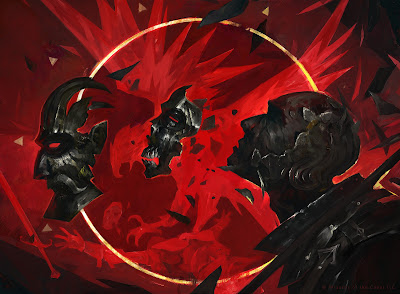
I've wanted to make a GLOG out of Dead Century for ages. Today, as we "celebrate" 70 years of the corpse-queen's impotent reign over this wretched isle, it felt appropriate to try and hammer some of it into shape, neatness be damned. So, in the hope of breaking my creative block and maybe harnessing the momentum to do some more work on OLOG, here are the beginnings of a system, I guess. Concrit very welcome. Here's a pretty picture; there's naught but rules under the cut.

"Crowded Crypt", art by Jarel Threat

Friday, 14 January 2022

[GLOG?] Pain

I've been doing a lot of design by subtraction recently. OLOG's main mechanical trick is that it does away with variable ability scores - there are still some calculated stats like Defence and Save values, but instead of Strength, Intelligence, Tastiness etc., you have Virtues.

What else can I tear apart and rework? I put most of this together on my lunch break. (This isn't going into OLOG, I just wanted to get the thoughts down.)

Pain

Hit points are gone. Damage rolls are gone. Replace them with Pain.

Pain is real, tangible harm, like getting hit with a weapon, fireball, or death curse. Lesser injuries might hurt or inconvenience you, but are not classed as Pain.

Creatures have a pain threshold (T). 1 is puny, 5 is hardy. Most humans have an innate Threshold of 3.

When you suffer Pain, roll a d6. If it exceeds your Threshold, you die.


art by Dominik Mayer 

If you'd rather not risk death every time you get hit, you big dirty coward, there are ways to protect yourself.

Wards

A Ward is something that can save you from Pain - think of it as sacrificial armour, something you can wager instead of your life. Here are a few things that serve as Wards:

  • A sturdy shield (an item).
  • A blessing of health (a buff).
  • A barricade to hide behind (an environmental element).
  • Your personal grit (a character ability).

Whenever you suffer Pain, you may invoke a Ward to change the stakes of the die roll. Instead of wagering your life, you wager the integrity of the Ward, and roll against its threshold rather than your own. If the d6 breaks the threshold, the blow is still absorbed, but the Ward is disabled and can't be used again, though it may recharge if some condition is met.

  • The shield breaks. It can probably be repaired.
  • The blessing wears off. It won't come back unless your party's priest casts it again.
  • The barricade cracks and crumbles. You could rebuild it, but you'd be starting from scratch.
  • Fatigue and stress set in and dull your grit, but you'll get it back as soon as you have a minute to rest.

Most Wards are not universal - there will be some sources of Pain against which they can't be invoked.

  • The shield won't help you against area attacks, or threats you don't see coming.
  • The blessing only wards you against mundane harm - magical attacks bypass it.
  • The barricade naturally only works against things coming from the other side of it.
  • Grit is a special case. We'll say this one is universal.

Other Considerations

Attack rolls and Defence are still assumed to be a thing.

Without variable damage dice, we need a new way to handle weapon power. Particularly powerful weapons could be represented in a few ways - powerful attacks could have a penetration value that reduces the threshold of physical Wards invoked against them. With this in mind, Wards could well have thresholds higher than 5. These Wards never fail under normal conditions - you'll need a penetrative weapon to break them.

Especially nasty attacks, like dragon breath and killing curses, could potentially cause multiple rolls' worth of Pain, either to single targets or spread out across a group. You can't use the same Ward more than once against the same attack.

I'm still not sure how to handle body armour. It could be a simple Defence buff, but that feels against the spirit of the system. It could be its own Ward, but having a whole suit of armour fall apart to a single decisive hit feels silly; I considered armour having a degrading threshold (it gets worse as you take more hits) but that's a bit too fiddly for my tastes. My current, provisional ruling is that armour increases your personal threshold, but is subject to being partially or fully ignored by penetrating weapons - maybe it's like

  • Unarmoured: T3
  • Leather: T4
  • Chain: T5 - you can get through with a non-penetrating weapon, but it's going to be tricky
  • Plate: T6 - penetrating weapons needed to do any harm

Nonlethal attacks work the same as lethal ones, but the failure condition is "you're unconscious" or similar rather than "you die".

Instead of dealing extra damage, critical hits bypass almost all Wards.

You might also be able to attack some Wards directly if you want them gone. If successful, this forces a roll against that Ward, rather than the target getting to choose.

Pain in Action

The anti-priest Arlene, hastening home to her safehouse, feels her heart sink as hoofbeats echo behind her. An errant Stag-Knight is tailing her, no doubt seeking the bounty on her head.

Arlene has:

  • Personal T4, including a +1 bonus for her leathers.
  • Grit (T2), as she's not really a fighter.

The Stag-Knight has:

  • Personal T5, including a +2 bonus for his chainmail.
  • Grit (T4), he's an experienced warrior.
  • A shield (T3).

As a straight fight, this isn't looking good for Arlene; her magic is almost spent, and she doesn't have a weapon powerful enough to be of use against chainmail. She'll need to be smart to have a chance of survival.

Arlene turns on her heel and draws her bow, taking a potshot at the approaching Stag-Knight. The arrow finds its mark, so now the Stag-Knight faces Pain. He chooses to invoke his shield, rolls a d6, and gets a 3, not enough to break his shield's threshold of 3. The arrow buries itself deep in the wooden board, but the shield holds

The Stag-Knight dismounts as he reaches Arlene and draws his sword, ready to cut down the infidel before him. His swing connects, so now it's Arlene's turn to face Pain. She invokes her meagre grit, figuring she'll need as many extra chances against this foe as she can get, and rolls a 3, enough to break her grit threshold. She ducks beneath his hopeful high swing, but it's close.

With her grit disabled, Arlene has no Wards left, and any blows that land on her now will be potentially deadly. She drops her bow and makes a show of drawing a blade of her own, teeth gritted in desperation. The Stag-Knight watches her sword arm with fierce focus, and doesn't catch the subtle swell of violet-edged darkness coiling around her other hand.

She slams her left hand into the Stag-Knight's flank. Castigate is a potent curse, inflicting two separate Pains. The Stag-Knight wasn't expecting this attack, so he can't invoke his shield again; he invokes his grit against one Pain, but can't use the same Ward twice against a single attack, so he has no choice but to suffer the other directly to his body.

He resolves the first Pain against his grit, and rolls a successful 2, but it doesn't matter. The second, resolved against his body, rolls an unlucky 6. The sweet, calculated words of Him Below flow through the Stag-Knight's body like molten iron, and he collapses, steaming, to the ground.

Arlene catches her breath and retrieves her bow. Having had a moment to recover, her grit recharges - should she get into another fight, she'll be able to use it again. But no amount of grit can protect her from her patron. The castigate that felled the Stag-Knight used more of His power than she's earned, and the accountants Beneath never sleep.

But Why, Though?

It makes combat scarier, and gives me interesting dials to turn, to make characters tougher in different ways. Heavy armour, hard-won fighting experience, and magical protection can all impact a character's toughness, and they can do so in different ways (increased personal threshold, increased grit, and a whole separate Ward, respectively).

It is also badly in need of refinement and testing, but getting the ideas out early can't hurt!

Monday, 27 December 2021

[OLOG] The Orc Armoury

Lore TBA, but basically orcs have different weapons from humans, especially melee weapons, and they tend to be rather specialised. Bones are orc currency (not actual bones, domino-shaped coins with holes in them, often braided together on strings for convenience). 1 bone = 1sp for conversion purposes.

Fortes

Most weapons have a forte (F:) listed. If the condition for a weapon's forte is met, roll a d12 in addition to the normal damage die and take whichever result is higher.

Lesser Weapons

1d6 damage, 1 slot. Require one hand.

  • Improvised weapons are considered lesser weapons, but do not have a forte, and may require more than one hand depending on their nature.
  • Unarmed attacks count as lesser weapons with no forte, and can't deal damage to an alert, steady opponent - you'll need to stun them, knock them down, or catch them unawares to get that damage in. Consider a manoeuvre instead. (More on those in a future post.)

There's only one lesser weapon you can actually buy. A decent knife costs 5 bones; paying more will get you a prettier one.

  • Knife - Orcish knives are usually big, heavy, and utilitarian. Not balanced for throwing.
    F: Your target is not expecting combat or malice.

One-Handed Weapons

1d8 damage, 1 slot. Require your dominant hand (you can effectively carry a shield or lesser weapon in your off-hand, or leave it free for other purposes). 50 bones each.

  1. Arc-Sword - A scimitar with most of its weight concentrated towards the sharply curved centre of the blade.
    F: You moved into engagement with the target this round.
  2. Boarding Axe - A favourite of marines - an axe with a sturdy spike set into the back of the shaft.
    F: Your target is not on stable footing.
  3. Butchermaul - A wicked axe-mace, with multiple blades and crushing heads to hew, hack, and rend.
    F: Your target has a bestial body plan.
  4. Cull-Knife - This huge triangular knife has serrated edges and a reinforced, needle-sharp tip.
    F: You are not under pressure.
  5. Mace - Any one of dozens of variations on the theme of "injurious weight on a stick".
    F: Your target is unarmed.
  6. Shredding Axe - This axe has serrated teeth at its head, spread in multiple directions like barbed wire.
    F: Your target is at half hit points or less.
  7. Squaresword - A thick, heavy sword with a hard right angle at the tip and a well-honed chopping edge.
    F: Your target has an orcoid body plan.
  8. Straightsword - This sturdy broadsword demonstrates refinement or arrogance, depending on who you ask.
    F: Your target is not engaged with anyone but you.
  9. Strife Axe - Ubiquitous in any orc military, this simple axe has a distinctive, slightly forked head.
    F: Your target is wielding a manufactured melee weapon.
  10. Wedge Hammer - The head of this short warhammer is set with a wedge to concentrate its crushing strength.
    F: Your target is significantly smaller than you.

Two-Handed Weapons

1d10 damage, 2 slots. Require both hands. 100 bones each.

  1. Coroner's Coil - A length of razor-edged chain between two handles, like a deadly skipping rope.
    F: Your target is animate but not alive.
  2. Felling Spike - A spear with its head bent at a slight angle; some models have hooked heads.
    F: Your target is mounted.
  3. Harvest Sword - Traditionally, this greatsword has seven teeth placed asymmetrically along its twin edges.
    F: Your target has 2HD or less.
  4. Hawk's Talon - Many variants exist of this hooked fork - the Hawk's Talon has three tines and a ripping spike.
    F: You are flanking your target.
  5. Meat Hammer - This hammer's broad, spiked head is too heavy to swing in any direction but down.
    F: Your target's movement is restricted.
  6. Scour-Axe - Three narrow heads top the shaft of this poleaxe, ideal for punching through hide or metal.
    F: Your target is wearing manufactured armour.
  7. Skewer - This barbed harpoon has a weighted head and twisting blades running along its front third.
    F: Your target is at least twice your size.
  8. Soulcatcher - A hooked claw on a stick, reputed to be able to drag the soul right out of one's body.
    F: Your target has cast a spell or used a magical ability this combat.
  9. Wailer - Takes its name from the awful whistling noise of air passing through the heavy, ventilated axehead.
    F: Your target is not combat-trained.
  10. War Sun - This polearm's vicious circular blade is spun by a clever system of weights when the weapon is swung.
    F: Your target is unarmoured.

Ranged Weapons

Orcs tend to view ranged combat as unglamorous but necessary - fighting at range isn't craven or dishonourable, but it's strictly a skill where melee combat can sometimes be an art.

  • Sling - 1d6 damage, 1 slot. Requires both hands to load, but only your dominant hand to fire. 20' effective range, -2 to hit for each 20' or part thereof beyond that. 10 bones.
    Sling stones are functionally free. They stack up to 10 per slot.
    F: Your target is within 10'.
  • Bow - 1d8 damage, 1 slot. Requires both hands. 30' effective range, -2 to hit for each 30' or part thereof beyond that. 50 bones.
    Arrows cost 1 bone for a bundle of 5, and can stack up to 20 per slot.
    F: Your target doesn't know where you are.
  • Crossbow - 1d10 damage, 1 slot. Usually requires both hands, but can be fired (not loaded) with only your dominant hand at a -2 penalty. 30' effective range, -2 to hit for each 30' or part thereof beyond that. Takes an action to reload. 125 bones.
    Quarrels cost 2 bones for a bundle of 5, and can stack up to 10 per slot.
    F: You haven't moved for at least 1 round.
  • Clicker Crossbow - 1d10 damage, 1 slot. Usually requires both hands, but can be fired (not loaded) with only your dominant hand at a -2 penalty. 30' effective range, -2 to hit for each 30' or part thereof beyond that. Carries a clip of 5 quarrels, no need to reload between them, but takes 3 consecutive actions to change clips. 200 bones.
    Quarrels cost 3 bones for a clip of 5, and can stack up to 10 (2 clips) per slot.
    F: You fired the clicker at the same target last round.
  • Javelin - 1d10 damage, stacks up to 3 per slot. Requires your dominant hand to throw. 20' effective range, -2 to hit for each 20' or part thereof beyond that. 10 bones for a bundle of three.
    F: This is your first attack this combat against this target.

Armour

Heavy armour is a rarity out in the badlands. Every layer of plate you strap on is one more bundle of supplies you can't carry. Still, some warriors want more protection than agility and luck alone can provide.

  • Hide Armour - 2 slots, +2 Defence. 50 bones.
  • Plated Coat - 1 slot, +2 Defence, stacks with hide armour. 100 bones.
  • War-Plate - 3 slots, +6 Defence. While wearing war-plate, each level of fatigue occupies 2 slots. At least 500 bones, and many settlements don't have the necessary tools to make it.
  • Shield - 1 slot. Occupies one hand. No Defence bonus normally, but doubles the bonus you get from taking an action to defend yourself. A readied shield also counts as a lesser weapon (with no forte). 50 bones.

Design Notes

"Less armour, more weapons" is the order of the day. The OLOG Marine has abilities that incentivise switching weapons and having a diversity thereof, so I think it's important that different weapons have different qualities.

This post was heavily inspired by this one from Chris McDowall. I especially liked the idea of weapons saying something about their wielders - an enemy orc with a straightsword should hopefully give off a very different impression from one with a hawk's talon.

I still can't make up my mind about how to treat non-orcish weapons. My instinct is to have a table of which orc weapons they map to, but that feels clunky. Maybe I go all-out and write unique fortes for them, too; that gives you an interesting extra incentive to loot human, elf, goblin, and demon foes.

Tuesday, 23 November 2021

[GLOG] Wizard School: Practical Necromancer

A GLOG Wizard School based on my fluff post about low-status working necromancers. Use with your wizard class of choice - I favour this one.

Starting Equipment: spellbook, cheap pen you got for free at some careers event 1d10 years ago, guild membership card, sewing kit, flask of embalming fluid.

Perk

You can sacrifice a drudge you control within 30' to reroll a mishap roll with a -1 modifier. If this new roll is 0 or less, the mishap is negated. You can keep doing this if you have more drudges to sacrifice, and the modifier is cumulative.

Drawback

Your skin is desaturated and papery and you smell a bit wrong. This doesn't penalise stealth, but you are very obviously a necromancer and will be treated as such, with disdain, apathy, or, worst of all, pity.
Also, when you die, your body will reanimate instantly (as raise drudge) and march by the most direct route possible to the nearest Necromancers' Guild chapterhouse for processing.

Cantrips

1) With a touch, set a timer in a willing creature's body which causes their skeleton to vibrate, harmlessly but noticeably, when the time elapses. Can be set for up to 24 hours, in increments of 1 minute.
2)
With a touch, lock a willing creature's limb or digit in position from a chosen joint, impervious to pain, fatigue, and muscle strain, until they release it with a command word.
3)
Your breath repels ordinary vermin up to the size of a mouse.

Mishaps

1-3) Same as the "generic" mishaps for your system of choice.
4) Become undead for 1d6 hours.
5) Reroll your Constitution on 2d6+1. Lasts 1d6 hours, then Save; permanent if you fail.
6) Drudges ignore your commands for the next 24 hours.

Dooms

1) Your metabolism twists painfully. Halve the effect of all healing you receive, mundane or magical.
2) Your senses deaden and your muscles grow cold and stiff. Disadvantage on initiative rolls and on anything that demands reflexes or reaction speed.
3) Your deadman's switch misfires and attempts to reanimate you, but, since you're still (just about) alive, it only takes your body. You remain alive as you march off to the chapterhouse, though hunger and exposure will probably kill you before you get there.

Spells

0) Raise Drudge
R: 15', T: [dice] roughly humanoid corpses, D: 0
This is always your first starting spell, even if you'd normally roll for your spells. Determine your other spells normally.
This spell takes 10 minutes to cast.
You reanimate the target corpses as drudges (see below for stats), specialised undead built for manual labour. Drudges stay under your control indefinitely and obey your spoken commands absolutely, and you always know their positions relative to you. You can destroy a controlled drudge at will with a command word. Drudges are also destroyed if you travel more than [max MD] miles away from them.
Whenever you cast a spell with a range listed as 0, you may choose a drudge within 60' to count as the caster.
You can't usually control more drudges than you have maximum MD; you can use this spell to reanimate them beyond that limit, but the MD you use stay invested permanently, one per target, until the drudge is destroyed. Creatures that temporarily count as drudges due to other spells don't count towards this limit.

1) Vigour Mortis
R: 30', T: any number of drudges you control, D: [highest] hours
For the duration, the targets work [dice]+1 times as fast as they ordinarily would on simple manual labour tasks - digging, chopping wood, laying bricks, and so on.

2) Necrophone
R: touch, T: one drudge you control, D: [highest] hours
The target becomes a conduit to the spirit realm. You can speak messages into it to relay them to the ether, allowing you to communicate with spirits, ghosts, and most forms of undead regardless of linguistic or metaphysical barriers. They can talk back to you and the target translates in a gnarly, rasping monotone.
Two drudges enchanted with Necrophone can be used to relay messages to each other like CB radios, with no maximum range besides your maximum control range for your drudges.

3) Sweep
R: 0, T: [dice]x20' radius area around caster, D: 0
All loose, lightweight debris in the area is drawn to the caster like a magnet - dust, leaves, papers, anything a gust of wind could blow away. This doesn't harm the caster, even if the debris normally would. The debris remains stuck in place until peeled or swept off.

4) Hazard Protocol
R: 30', T: up to [dice] contiguous 5' cubes, D: [sum]x10 minutes
Everything in the targeted area becomes temporarily safe to handle. All chemical, biological, and radiation hazards are neutralised, though physical damage and magical threats are unaffected. Creatures with special attacks that would be neutralised may Save to resist.

5) Detonate Drudge
R: 60', T: one drudge you control, D: 0
At the start of each following round, roll 1d3. On a 1, the target explodes with percussive force, destroying it and dealing [sum] blunt-force damage in a [dice]x5' radius. This explosion doesn't start fires.

6) Fumigate
R: 0, T: [dice]x10' radius area around caster, D: 0
A cloud of toxic gas billows from the caster. Each living creature within range up to the size of a large rat takes [sum] damage, dissipating into smoke if killed this way. Exceptional or magical creatures can Save vs. poison for half damage. Living creatures bigger than a rat take [highest] damage and always get a Save.
This spell's area of effect is doubled if used in an enclosed space.

7) Necroinfusion
R: touch, T: one willing creature, D: [dice]x10 minutes
The target temporarily, partially necrotises. They get +4 to Save against metabolic hazards like poison and disease, and are affected as both a living creature and an undead, whichever is better for them. They also count as a drudge under your control, as though raised with raise drudge, for the purposes of targeting them with spells and casting your spells through them.

8) Rot Minerals
R: 0, T: [dice]x5' cone originating from source, D: [sum] minutes
When you cast this spell, choose stone, metal, or vegetable matter. Within the target area, the chosen material decays and takes on the consistency of very stale porridge - it holds its shape, but interfering with it will quickly collapse it into lumpy sludge. Precious metals and lead are unaffected.

9) Subvert Undead
R: 60', T: one undead, D: special
You attempt to seize control of the target. Compare your [sum] to the target's HD. If you match or beat it, the target falls temporarily under your control, and is treated as a drudge for the purposes of targeting it with spells and casting spells through it. The duration depends on the margin by which you won:
[sum] >= HD: [dice] rounds, during which the target is stunned and immobile.
[sum] >= 2xHD: [dice] rounds.
[sum] >= 3xHD: [dice] minutes.
[sum] >= 4xHD: [dice] hours.

10) Scourskin
R: 0, T: self, D: [sum] minutes
The caster's skin becomes powerfully alkaline and solvent. It can burn markings into almost any material, neutralise adhesives, and inflict [dice]d3 damage with a touch, or [dice]d6 against oozes and similar acid-based creatures. The caster is also immune to acid for the duration.

11) Render
R: 30', T: any number of living and/or undead creatures and/or corpses, D: 0
Over the next 10 minutes, up to [sum] HD of the chosen creatures, lowest HD first, and all chosen corpes, are rendered helpless, ground and compressed together into a single homogeneous lump of meat, gristle, and bone dust. This is usually fatal. Creatures may Save to escape at intervals based on their HD; on a successful Save, they emerge having taken 1d6 damage for each prior failed Save, which may kill them regardless.
HD < [dice]/2: No save.
HD < [dice]: On cast.
HD >= [dice]: On cast and 5 minutes later.
HD >= 2x[dice]: On cast and 4 and 8 minutes later.
HD >= 3x[dice]: On cast and 3, 6, and 9 minutes later.

12) Graveyard Shift
R: 120', T: roughly humanoid corpses, D: [dice] hours
You must invest at least 2 [dice] to cast this spell. It takes 10 minutes to cast.
As raise drudge, but affects up to [sum] corpses within range. They last only for the duration and don't count towards your limit.

Monster: Drudge

HD: 1
Defence: as leather
Move: normal, half normal underwater (can't swim, can walk along the bottom)
Morale: immune
Intelligence: programatically precise but only as good as its instructions
Speech: none, understands creator's language
Damage: 1d6 punch, only when specifically ordered, can only attack every other round, can't use weapons
Special: effective Str 18 for lifting, carrying, and other menial feats of strength; perfect internal clock, accurate to the second

A damaged drudge can be repaired to full hit points with 10 minutes' work. When destroyed, a drudge collapses into fine grey dust, and can't be re-reanimated.

Monday, 6 September 2021

[GLOG] The Bardtillerist

In eras past, in the distant heights, the mountain kingdoms declared war on heaven. Keen to weaponise their strong bardic tradition, the people of the heights sought new instruments of war. Drums and bugles were all very well for rallying troops and cowing mortal foes, but they needed something more, something that could drown out a choir of angels and reduce a thrice-blessed bulwark to rubble with a single note.

Thus, the Ur-Horn. Thus, the venerable order of bardtillerists.

Art by the talented and handsome K25fF - thank you!

You and your trusty cohorn are alumni of the Warchestral Academy, trained in the care and operation of a Contradivine Ur-Horn. Despite aggressive funding in recent years, the modern public sees bardtillery as quaint and archaic, and your promised places in the army vanished the moment you graduated. At least they let you keep the horn. They were probably too scared to take it off you.

Class: Bardtillerist

Starting equipment: Matching fancy uniforms, three daggers, a tuning fork, a huge shabby binder half-filled with yellowing sheet music, and, of course, an Ur-Horn.
Starting skill: Music Theory, plus roll 1d6 for your cohorn's skill - 1) Binge Drinking, 2) Herbalism, 3) Slam Poetry, 4) Card Games (legitimate), 5) Card Games (cheating), 6) Military History.

A: Ur-Hornist, Cohorn, +1BD, +1 random Harmony, +1 Harmony of your choice
B: Sundering Resonance, +1BD, +2 random Harmonies
C: Torrent of Sound, +1BD, +1HD for your cohorn
D: Unison, +1BD, +2 Harmonies of your choice

A: Ur-Hornist
Your Ur-Horn is 12' long, made from heavily treated wood and various enchanted metals (it detects as magical), and extremely heavy. The Ur-Horn takes up a total of 12 inventory slots, but the burden can be spread among up to four people moving together. It is indestructible by anything short of direct divine intervention. It's also irreplaceable, so don't lose it. Deploying the Ur-Horn for combat or stowing it takes one full round, shortened to one action if your cohorn also takes an action to help; it cannot be moved while deployed, but can pivot around its mouth.
The Ur-Horn demands impeccable breath control. You have a stock of Breath Dice, or BD, which are d6s, representing your reserves of stamina and lung strength. Depleted Breath Dice are restored after a night's rest.
When you spend a round doing nothing but aiming and blowing your deployed Ur-Horn, you can invest any number of your BD, rolling them. If you roll a 5 or more on a BD, it's depleted after use. If any two BD results match, all rolled BD are depleted after use.
The base effect of the Ur-Horn deals [sum] sonic damage in a 5x[dice]' radius sphere centred within 300' and line of sight, with a Save for half. This can be altered by Harmonies.
You can also use the Ur-Horn to play deafeningly loud music of decent quality. This doesn't cost any BD, and is audible up to 10 miles away per Bardtillerist template you possess, terrain permitting.

A: Cohorn
You are accompanied by a cohorn, a lower-ranking bard who is nonetheless a skilled sonic engineer in their own right and vital to many of your abilities. Name and briefly describe them. They are a generic 1HD hireling, of the same race as you, with no equipment save what you give them. Your cohorn costs no upkeep and doesn't count towards your hireling limit. They trust you with their life - they need never check morale if they can see or hear you, but automatically fail morale checks if not. Cohorns always follow the same rules for death and dismemberment as PCs.
When you play your horn, your cohorn can spend the round assisting you by checking ranges and frequencies, adjusting the Ur-Horn's valves and enchantments, and offering moral support. When they do, before rolling BD, choose and apply one Harmony they know to the usage.
If you lose your cohorn, you can replace them only by spending time on a mountaintop, doing nothing but eating, resting, and blowing your Ur-Horn; one will answer your call in 1d3+4 days.

B: Sundering Resonance
You can now use your Ur-Horn out of combat to deal massive damage to stationary, inanimate objects, vibrating them into packed but easily workable dust. Invest your BD at the start, blow for ten uninterrupted minutes, then roll the dice and pulverise [sum]+[dice] contiguous cubic feet of material (doubled for wood, halved for most metals, impossible for lead or enchanted material).

C: Torrent of Sound
When you blow the Ur-Horn after blowing it the previous round, gain +1 to each BD roll. This is cumulative as long as you keep blowing.

D: Unison
You can now apply a Harmony to your own use of the Ur-Horn, in addition to the Harmony your cohorn may contribute. The two Harmonies must be different.

Bardtillerist Harmonies

  1. Breath Control. You may choose to reduce one rolled BD value by 3 after rolling, to a minimum of 1, possibly avoiding a 5+ or a double.
  2. Solo. Only affects a single target, but damage is doubled.
  3. Belter. Affects a 10x[dice]' long, 10x[dice]' wide cone emanating from the Ur-Horn.
  4. Bypass. Choose one mundane material, like wood, stone, or copper; the effect passes through that material as though it wasn't there. You must still have some way of finding your target, like a spotter or a really big mirror.
  5. Disrupting. Doesn't affect living creatures, but undead, constructs, and angels Save with disadvantage.
  6. Earthshaker. Grounded targets who fail their Save are knocked prone.
  7. Skybane. Flying targets who fail their Save are pulled 20x[dice]' downwards, taking fall damage as usual if they hit the ground.
  8. Coruscating. Damage dealt is fire instead of sonic, and can set flammable objects alight.
  9. Muffle. Damage dealt is nonlethal. Enemies reduced to 0hp are rendered unconscious and will wake up in an hour with 1hp.
  10. Fiend's Interval. Instead of damage, targets take a -[dice] penalty to morale checks for [sum] minutes.
  11. Rending. Instead of damage, targets take a -[dice] penalty to AC for [sum] minutes, to a minimum of their unarmoured AC.
  12. Prelude. Instead of damage, targets take a -2x[dice] penalty to their saves against your Ur-Horn for [sum] minutes.

Design Notes

What if a military weapons team had an alphorn instead of a machine gun?

The Bardtillerist's toolkit is perhaps more robust than a standard wizard's, only losing dice on a 5+ or a mishap and suffering no other penalties for mishaps. My hope is that they pay for this in awkwardness. The Ur-Horn takes time to set up and tear down, you're very limited in what you can do with it, and you need the help of a fragile, difficult-to-replace ally to get the most out of it.

One night's work. Probably needs refining, but I absolutely had to get this written down the moment the idea struck.

Saturday, 10 July 2021

[GLOG] Jousteian Demiclasses

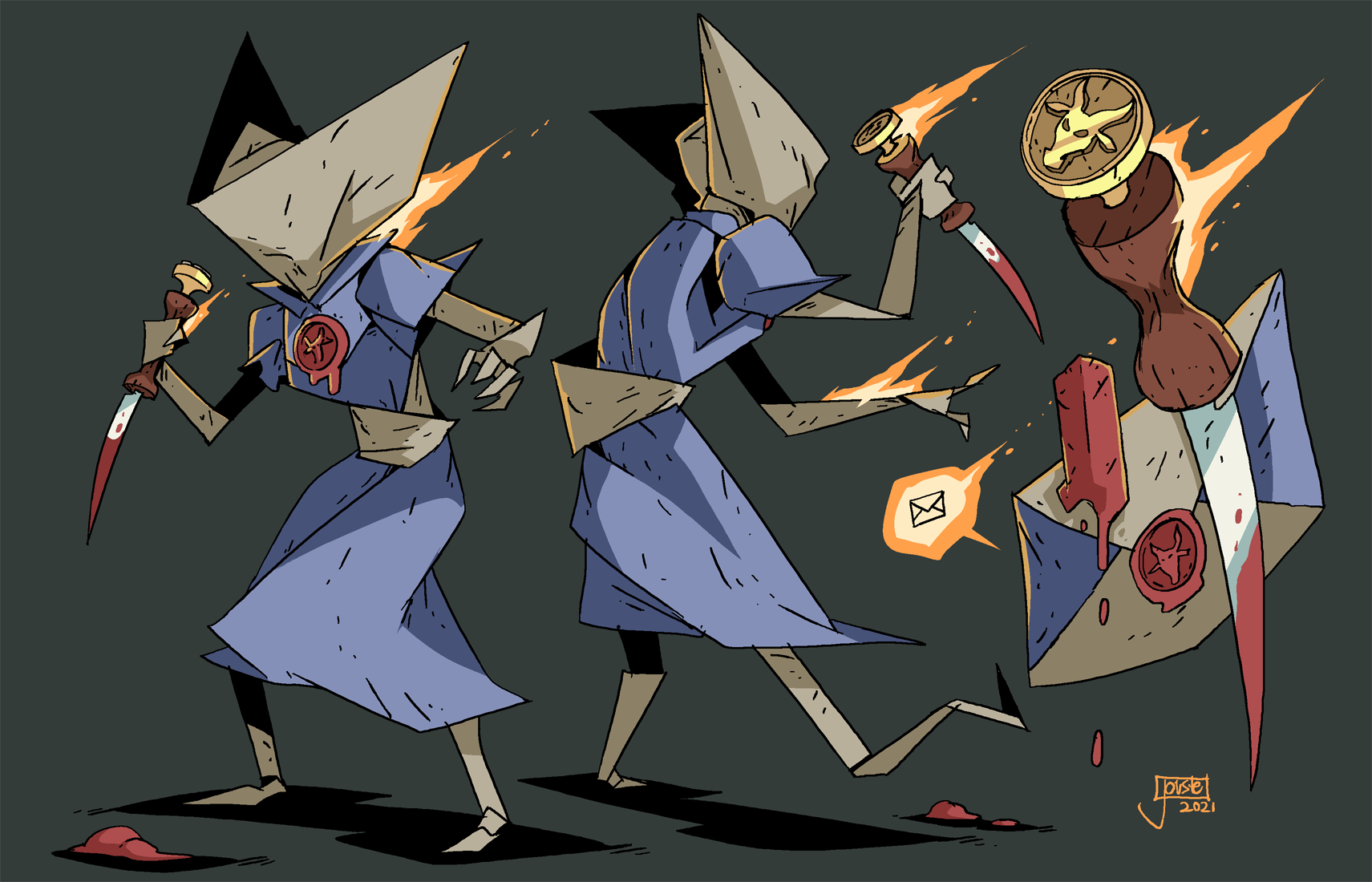
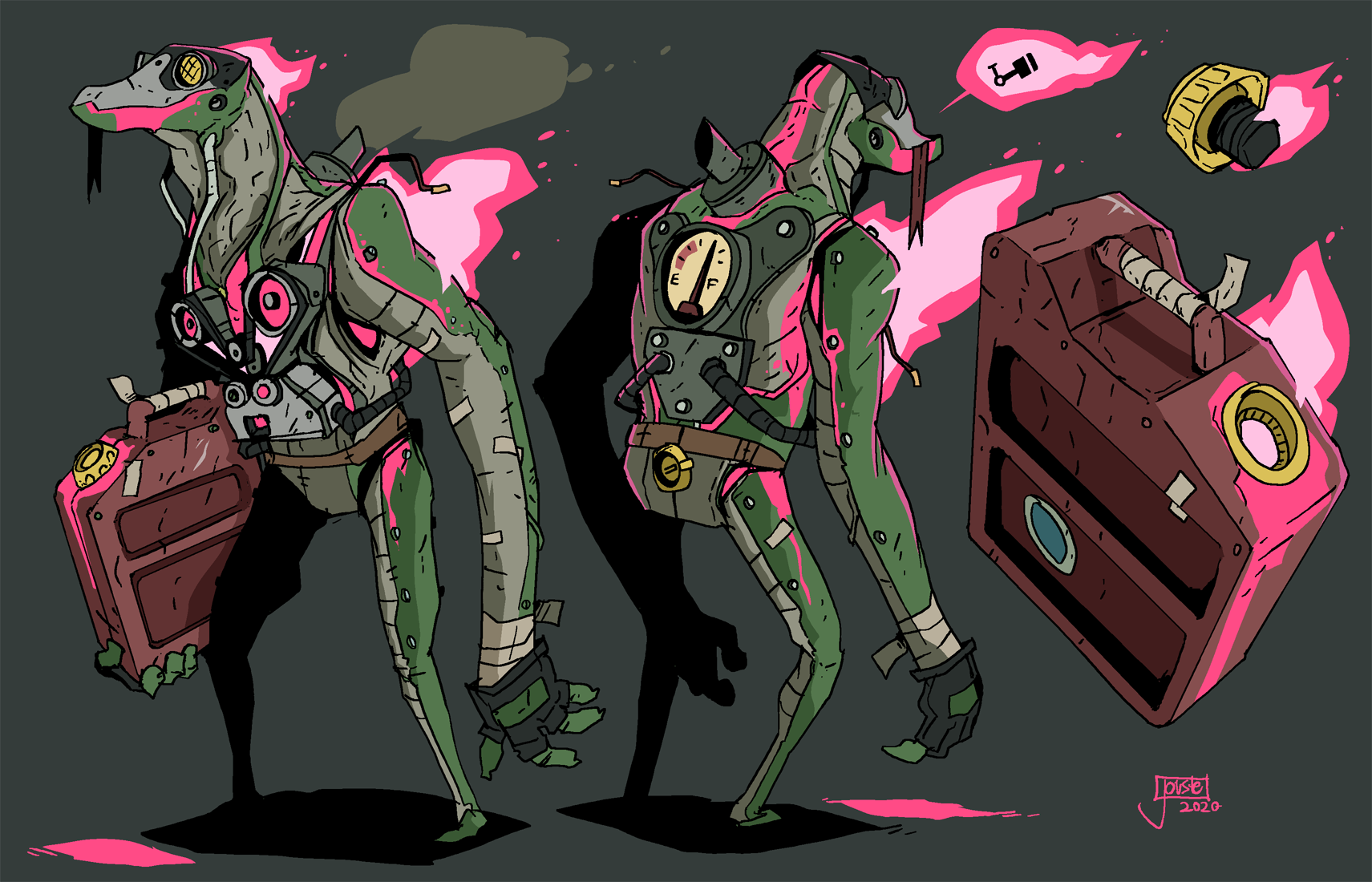
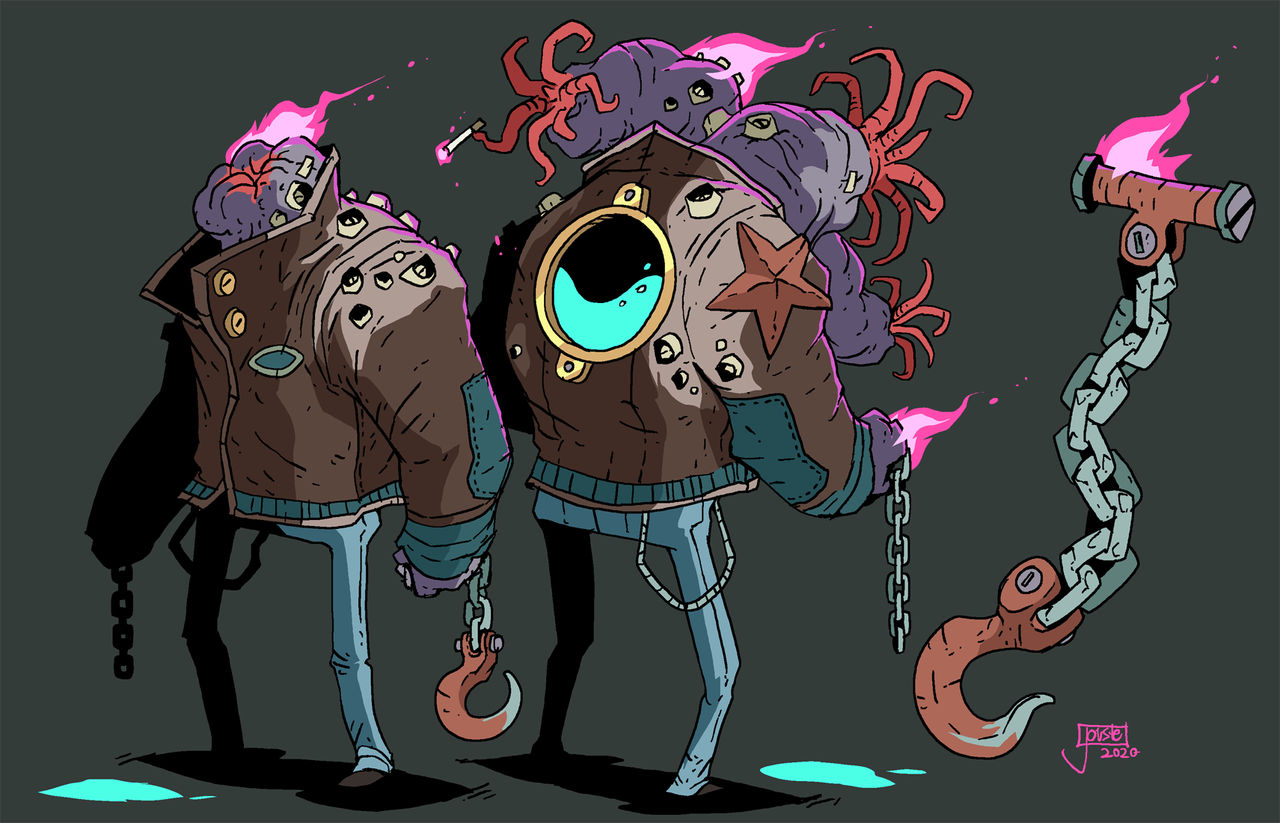
Recently, some passing acquaintances and fairweather allies of mine on Discord pointed me towards the works of Canadian artist jouste (to whom I credit all the visual art in this post). Someone joked about a GLOGhack where this portfolio was the class list. Here's what I've come up with in response.

Each of these classes is inspired by one of jouste's pieces. They're just like regular GLOG classes, except that you can only enter them at first level, you don't have a race / species / ancestry if you take one, they come with special dietary requirements, and they only have A and B templates. Fill out your other template slots with other classes.

Class: Epistolemure

Starting skill: 1d3 - 1) Bureaucracy, 2) Calligraphy, 3) Debating.
Starting equipment: Knife, fountain pen, signet ring (draw your sigil), blank 100-page notebook, indefinite supply of black ink, up to 1oz per day of molten wax secreted from your chest cavity (1d8th colour of the rainbow, black on an 8).
Diet: Ten sheets of ordinary letter-sized paper equal one ration. High-quality paper counts double. Spellbook pages count quintuple, but are dangerous (Save or gain a random mutation). You don't need to drink.
A: +1 Stealth. You can't wear armour, but your hardened skin and agility count as Leather that doesn't encumber you. As an action, fold yourself up into a flat form with the size, weight, and general appearance of a letter, or unfold yourself to full size. Equipment doesn't transform with you. In letter form, you can't see, speak, or move under your own power, and are indistinguishable from a letter unless someone tries to open you or sets you on fire, at which point you instantly revert to normal.
B: +1 Stealth. You can write (but not necessarily read, speak, or understand) any language you know about. You may allow yourself to be opened, and know how to write on yourself such that the message will appear in the opened letter. If you ingest a dose of poison as you transform, it doesn't affect you as long as you stay in letter form, and, if anyone reads you, you transfer that dose to them in full, losing the poison yourself and forcing them to Save against it.

Class: Fueldrake

Starting skill: 1d3 - 1) Arsonist, 2) Mechanic, 3) Stage Technician.
Starting equipment: Wrench, tinderbox, lizard leathers (armour as leather), two jerry cans. Each can holds up to 30 pints of liquid and consumes one inventory slot per 6 pints or part thereof. One contains 1d6+3 pints of lamp oil, the other 1d6+3 pints of [1d6 - 1) vegetable slurry, 2) glue, 3) acid, 4) magenta paint, 5) blood, 6) cheap, horrible sake].
Diet: One pint of lamp oil equals one ration. You can substitute any flammable liquid that would give you the same amount of burn in a lantern - no solids. You don't need to drink anything else.
A: +2 Movement. You can speak with fuel. Most fuel isn't terribly bright and its memory is limited to a day, but it's enthusiastic and overconfident to a near-suicidal degree.
B: +2 Movement. You are telekinetic, with strength and speed equal to your own and reach as far as you can perceive, but it only works on things that are currently on fire.

Class: Crystopian

Starting skill: 1d3 - 1) Hazardous Materials, 2) Mad Science Power Source, 3) Particle Physicist.
Starting equipment: Unstable raygun (range as bow, 1d3 or 2d3 damage, 3s explode, each explosion deals 1 damage to you), two metal legs, one metal arm.
Diet: Spending an hour in direct sunlight or consuming an ounce of radioactive material counts as one ration. You don't need to drink - in fact, you can't drink.
A: +2 Defence, -2 hp. You're immune to ionizing radiation. You can't wear armour, but your crystalline body and scavenged metal limbs count as Chain. You can replace any limb with 10 minutes' work and a suitable replacement, or spend 10 minutes to re-engineer an arm into a leg (but not vice-versa). Anything metallic, articulated, and roughly the size of a human limb works as a leg, but arms need some sort of manipulator. You can have up to three limbs in any combination at any given time. Each leg beyond the second grants +2 Movement. One leg halves Movement. You can't move at all with no legs.
B: +2 Defence, -2 hp. You can now support up to five limbs at a time. While you have at least three arms, you gain an extra attack per round, but you must make it with a different limb from your first.

Class: Rogue Ultrabenthic Tendril

Starting skill: 1d3 - 1) Angler, 2) Longshoreman, 3) Pirate.
Starting equipment: Rusty hook on a chain (as flail), sealeather jacket (armour as leather), 1lb bag of salt, symbiotic starfish companion, 3 jars of dead plankton in brine (1 ration each, to you), vial of sapient water from the Ultrabenthic Flowmind (telepathic, hates you).
Diet: You drink saltwater as much as a human drinks fresh water, and you can only eat creatures that live in it. You can drink fresh water and other liquids, but they don't sate your thirst. (For reference, half an ounce of salt turns one pint of fresh water into saltwater.)
A: You sink in water, and can breathe underwater indefinitely. You gain an extra attack per round with your stinging tentacles, useable only at very close range. On a hit, the target Saves vs. paralysis and becomes unable to breathe, vocalise, or use breath-based abilities for 3 rounds on a failed save or 1 round on a success. This duration stacks with itself, and a creature thus affected for 10 consecutive rounds dies. All ordinary sea life is mortally terrified of you.
B: If you hit with a tentacle attack, you can make another one immediately. You can speak telepathically with any creature that breathes, but will always come across as aggressive and hateful, whatever your actual sentiment.

Saturday, 8 May 2021

[GLOG] The Hound of the HIGHEST

Evil smells bad. Everyone knows this - from putrid corpse-scent to the heady reek of pestilence (which is, of course, spread by corrupted air), the works of Him Below leave a foul miasma on the world that offends the senses and disquiets the soul.

What some don't realise is that it's not merely the products of wickedness that leave clues in the air. Sin itself has a smell. The five Mortal Transgressions each leave their own distinctive marks upon the air, too subtle and insidious for the untrained nose. With practice, though, they are all too easy to sniff out.

The Hounds of the HIGHEST are a loosely-knit holy order separate from the three great churches. Their senses of smell are finely attuned to the evils of the world, and, to hone it, they must spend time bathing themselves in that same wickedness, thus their high attrition rate for new recruits and their terrible reputation among more conventional clergy. Still, those who can brave the Transgressions and come out with their faith intact are investigators without compare. Tannists, Venerables, and Absancts alike spurn the Hounds in public, but every bishop worth her salt knows when to call for their aid.

Some grow tired of serving the churches, though, and decide their talents would be better used elsewhere, in the dark, forgotten places of the world.

These are their stories.

Demi-Class: Hound of the HIGHEST

Starting equipment: Plain steel censer (as flail) with 2d4 phials of holy incense (burn for an hour each), notebook, pencil, Edicts of the Heights (Wodelyn translation, heavily defaced), pewter badge with bloodhound sigil.
Starting skill: Roll 1d3 - 1) Apothecary, 2) Hunter, 3) Perfumier.

For each Hound of the HIGHEST template you possess, you gain +1 Initiative as long as you have a functional sense of smell and your enemies have a scent, however slight.

A: Heaven Scent, Lingering Stink
B: Whiff of Suspicion, Burn Out the Stench

Several of the Hound's abilities rely on smell. These abilities are not magic and can't be dispelled or blocked by antimagic effects, but they can be foiled by strong mundane smells like perfume or dung.

A: Heaven Scent
You have a nose for the five Mortal Transgressions: Violence, Theft, Witchcraft, Oathbreaking, and Sedition. You can detect people and things associated with them, known as Transgressive Objects, by smell alone. By spending one round within arm's reach of such a thing - you needn't take any particular action - you detect the scent and learn which of the five Transgressions is most applicable and whether the subject is a Transgressor (one who's committed a Transgression), a Product (a direct result of a Transgression), or an Accessory (something associated with the commission of a Transgression). Victims have no particular scent unless they also fall into another category.

  • Violence: Weapons are Accessories, corpses and major long-term wounds are Products.
  • Theft: Stolen goods are Accessories, and anything stolen goods have been directly traded for is a Product.
  • Witchcraft: Magic (not priestcraft) used in unsanctioned or wicked ways. Spellbooks and other paraphernalia are Accessories, summoned creatures and ongoing magical effects are Products.
  • Oathbreaking or Sedition: Use your best judgement - these are too wide for a full list.

You can trace scents up to a week old, and discern when they're more than a day old.

A: Lingering Stink
Even successful Hounds have a hard time getting through training without falling into a few bad habits. When you gain this ability, roll 1d6 for a bad habit - 1) binge drinking, 2) narcotics, 3) gambling, 4) meaningless sex, 5) petty theft, 6) brawling. If you've indulged your bad habit in the last week, for no reason other than feeling the buzz, you gain a +2 bonus to all saves and heal 1 extra hit point with lunch. If you haven't, invert these bonuses.
This habit also gives you a constant miasma of low-level vice. It doesn't interfere with your abilities, but it does mask any greater Transgressions you might have committed, such that other Hounds and similarly trained people can never detect them.

B: Whiff of Suspicion
You can now trace scents up to a month old, and discern when they're more than a week old.
You can spend a round adjacent to a Transgressive Object to commit it to memory. Note down its nature and Transgression, such as "Darius the blacksmith - Witchcraft" or "the Eleventh Legion's lost pay chest - Theft". When you smell something connected to the same acts of Transgression, you will recognise the link; you'll know, for example, that Darius' familiar is linked to him (beyond simply being an Accessory to Witchcraft), or that the bandit camp on the Caul Road is associated with that stolen pay. You can retain only three memories at a time this way, and may drop them at any time.

B: Burn Out the Stench
You gain an extra attack per round which you can only use against creatures you've identified as Transgressors or Accessories.

Design Notes

The inspiration for this class comes from all over the place, but the trigger was an episode of Leverage, of all things, the one where they fake a miracle to save a church from being shut down. There's a minor plot point about the Vatican sending investigators to verify the miracle as legit, and the second thing this made me think of was whether it'd be cool to play one of those guys. (The first thing was the Monty Python "Church Police" skit.) The first version of this class was based around being able to discern whether magic was real or fake, but I realised pretty quickly that it would be very limiting, and had a think about what else church investigators might do. The other inspiration point was the running theme in many GLOG denominations of wizards being able to taste magic. What if priests had a similar sense, one more aligned with their identity? What if they could smell sin?

The Hound of the HIGHEST was originally going to be a full class, but my attempts to extend it to C and D templates felt like a stretch somehow, like I was overextending an already pretty limited idea. That said, I think I like it as a half-class. I figure the Hounds probably aren't close-knit enough to have all that much consistency between them, and we should have more half-classes regardless, since ease and simplicity of multiclassing is one of the GLOG's biggest strengths. Fill out your other two levels with some sort of thief if you want to stress the "holy scoundrel" angle, a different flavour of priest for some actual miracles, or a fighter class for a scent-based Punisher type.

I really need to write up more about the assumed theology behind my classes at some point.