A challenge by Library of Attnam, discovered via Archons March On.
This post is brought to you by PG Tips tea. PG Tips: It's What They Had At The Shop.

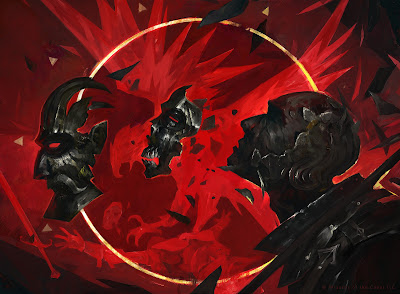
"Azor's Elocutors", art by Johannes Voss
A challenge by Library of Attnam, discovered via Archons March On.
This post is brought to you by PG Tips tea. PG Tips: It's What They Had At The Shop.
Dead Century is a setting I've been mucking about with for a long while. It's set 50 years after a magical zombie apocalypse called the Spasm, in the ruins of a world fought over by squabbling arch-necromancers, with a few pockets of human resistance flying under the radar, beneath notice compared to the grand schemes of the dead. I guess I'd call it "grimbright" - shit's bad, but there's hope for change, and the human spirit has persisted.
I've wanted to make a GLOG out of Dead Century for ages. Today, as we "celebrate" 70 years of the corpse-queen's impotent reign over this wretched isle, it felt appropriate to try and hammer some of it into shape, neatness be damned. So, in the hope of breaking my creative block and maybe harnessing the momentum to do some more work on OLOG, here are the beginnings of a system, I guess. Concrit very welcome. Here's a pretty picture; there's naught but rules under the cut.

I've been doing a lot of design by subtraction recently. OLOG's main mechanical trick is that it does away with variable ability scores - there are still some calculated stats like Defence and Save values, but instead of Strength, Intelligence, Tastiness etc., you have Virtues.
What else can I tear apart and rework? I put most of this together on my lunch break. (This isn't going into OLOG, I just wanted to get the thoughts down.)
Hit points are gone. Damage rolls are gone. Replace them with Pain.
Pain is real, tangible harm, like getting hit with a weapon, fireball, or death curse. Lesser injuries might hurt or inconvenience you, but are not classed as Pain.
Creatures have a pain threshold (T). 1 is puny, 5 is hardy. Most humans have an innate Threshold of 3.
When you suffer Pain, roll a d6. If it exceeds your Threshold, you die.
If you'd rather not risk death every time you get hit, you big dirty coward, there are ways to protect yourself.
A Ward is something that can save you from Pain - think of it as sacrificial armour, something you can wager instead of your life. Here are a few things that serve as Wards:
Whenever you suffer Pain, you may invoke a Ward to change the stakes of the die roll. Instead of wagering your life, you wager the integrity of the Ward, and roll against its threshold rather than your own. If the d6 breaks the threshold, the blow is still absorbed, but the Ward is disabled and can't be used again, though it may recharge if some condition is met.
Most Wards are not universal - there will be some sources of Pain against which they can't be invoked.
Attack rolls and Defence are still assumed to be a thing.
Without variable damage dice, we need a new way to handle weapon power. Particularly powerful weapons could be represented in a few ways - powerful attacks could have a penetration value that reduces the threshold of physical Wards invoked against them. With this in mind, Wards could well have thresholds higher than 5. These Wards never fail under normal conditions - you'll need a penetrative weapon to break them.
Especially nasty attacks, like dragon breath and killing curses, could potentially cause multiple rolls' worth of Pain, either to single targets or spread out across a group. You can't use the same Ward more than once against the same attack.
I'm still not sure how to handle body armour. It could be a simple Defence buff, but that feels against the spirit of the system. It could be its own Ward, but having a whole suit of armour fall apart to a single decisive hit feels silly; I considered armour having a degrading threshold (it gets worse as you take more hits) but that's a bit too fiddly for my tastes. My current, provisional ruling is that armour increases your personal threshold, but is subject to being partially or fully ignored by penetrating weapons - maybe it's like
Nonlethal attacks work the same as lethal ones, but the failure condition is "you're unconscious" or similar rather than "you die".
Instead of dealing extra damage, critical hits bypass almost all Wards.
You might also be able to attack some Wards directly if you want them gone. If successful, this forces a roll against that Ward, rather than the target getting to choose.
The anti-priest Arlene, hastening home to her safehouse, feels her heart sink as hoofbeats echo behind her. An errant Stag-Knight is tailing her, no doubt seeking the bounty on her head.
Arlene has:
The Stag-Knight has:
As a straight fight, this isn't looking good for Arlene; her magic is almost spent, and she doesn't have a weapon powerful enough to be of use against chainmail. She'll need to be smart to have a chance of survival.
Arlene turns on her heel and draws her bow, taking a potshot at the approaching Stag-Knight. The arrow finds its mark, so now the Stag-Knight faces Pain. He chooses to invoke his shield, rolls a d6, and gets a 3, not enough to break his shield's threshold of 3. The arrow buries itself deep in the wooden board, but the shield holds
The Stag-Knight dismounts as he reaches Arlene and draws his sword, ready to cut down the infidel before him. His swing connects, so now it's Arlene's turn to face Pain. She invokes her meagre grit, figuring she'll need as many extra chances against this foe as she can get, and rolls a 3, enough to break her grit threshold. She ducks beneath his hopeful high swing, but it's close.
With her grit disabled, Arlene has no Wards left, and any blows that land on her now will be potentially deadly. She drops her bow and makes a show of drawing a blade of her own, teeth gritted in desperation. The Stag-Knight watches her sword arm with fierce focus, and doesn't catch the subtle swell of violet-edged darkness coiling around her other hand.
She slams her left hand into the Stag-Knight's flank. Castigate is a potent curse, inflicting two separate Pains. The Stag-Knight wasn't expecting this attack, so he can't invoke his shield again; he invokes his grit against one Pain, but can't use the same Ward twice against a single attack, so he has no choice but to suffer the other directly to his body.
He resolves the first Pain against his grit, and rolls a successful 2, but it doesn't matter. The second, resolved against his body, rolls an unlucky 6. The sweet, calculated words of Him Below flow through the Stag-Knight's body like molten iron, and he collapses, steaming, to the ground.
Arlene catches her breath and retrieves her bow. Having had a moment to recover, her grit recharges - should she get into another fight, she'll be able to use it again. But no amount of grit can protect her from her patron. The castigate that felled the Stag-Knight used more of His power than she's earned, and the accountants Beneath never sleep.
It makes combat scarier, and gives me interesting dials to turn, to make characters tougher in different ways. Heavy armour, hard-won fighting experience, and magical protection can all impact a character's toughness, and they can do so in different ways (increased personal threshold, increased grit, and a whole separate Ward, respectively).
It is also badly in need of refinement and testing, but getting the ideas out early can't hurt!
Reddit user Deep_Fold trained an AI on D&D monsters and produced some fun images. Phlox challenged some of the gretchlings that coalesce and fester on his Discord server to put stats to them. This is me doing that.

Solitary, nocturnal jungle ambush predator. Sometimes attempts to disguise itself as a leaf, but, since it's the size of a horse, this doesn't work. Fortunately, it has other means of stealth.
HD: 4
AC: as chain
Move: normal
Morale: 6
Intelligence: stupid dog, practiced but predictable
Speech: wet reptilian grunting
Damage: tendril 1d8 / tendril 1d8 (odd rolls are acid damage, even rolls are bludgeoning); or blinding flash (see below)
# Enc.: solitary
Light-Snuffing Aura: Mundane light sources within 30' of the chlorophore are snuffed. Natural or magical sources are suppressed. The chlorophore can turn this aura on and off at will.
Blinding Flash: Used instead of an attack. The chlorophore releases stored light in a hot bright wave. Everyone in a 60' radius must Save or be blinded. If you fail two consecutive Saves, it's permanent. The chlorophore must snuff five torches or lanterns, or spend a day sleeping in direct sunlight, to recharge this ability.
If harvested within an hour of death while charged, a chlorophore's light glands can be used as flash grenades, or sold for 10gp apiece to a sufficiently sketchy alchemist.

Wise librarians know it's bad luck to shelve too many sad stories, especially true ones, in close proximity. Only the very wisest librarians know why. Tragedians are creatures of ink and sorrow, crawling off the page to drown the world in misery and melodrama.
HD: 1
AC: as leather
Move: normal
Morale: 10
Intelligence: florid and articulate but wholly irrational
Speech: half-coherent babbling about various horrible things (use this post for inspiration)
Damage: draining touch 1d6-3 plus misery (see below)
# Enc.: moan of 1d4+2 or lamentation of 2d6
Misery: If a tragedian's draining touch rolls net 0 damage or less, it instead inflicts 1 point of misery. If the target already has 5 or more points, instead it's 1d3 Wisdom damage.
Apply your current misery as a penalty to all d20 rolls. Whenever you fail a roll that you would have succeeded on if not for your misery, Save or spend the next round doing nothing but wailing, sobbing, and lamenting your failures.
Receiving a vigorous pep-talk in a safe place from someone with no misery, which takes at least a minute, removes all your misery.
Tragedian bodies contain about a pint each of useable ink. Writing with tragedian ink is said to improve your command of language.

An undead hybrid creature made from cursed permafrost and the blood of a hypothermia victim. Cold Artists use shard puppets as guards and enforcers. The wicked fever they can bestow is often considered a fate worse than death; they do not hand it out wantonly, but won't hesitate to make examples if their masters' edicts are disrespected.
HD: 8
AC: as chain; half damage from slashing and piercing weapons
Move: normal, fly normal
Morale: 9
Intelligence: mostly obedient servants, but just enough initiative to keep you guessing
Speech: low telepathic growl
Damage: claw 1d8 / claw 1d8; or blood feed (special, see below)
# Enc: solitary or troop of 1d3+3
Edge Fever: Anyone who ingests shard puppet blood contracts edge fever. Whenever you critically fail a melee attack roll against a shard puppet, Save; if you fail, some of its blood got in your mouth, and you now have edge fever. A shard puppet can also use its attack action against a restrained target to force-feed them blood, in which case they also get a Save.
Edge fever's symptoms are a slightly raised temperature, mild lethargy, and automatically failing all Saves. Swallowing a lump of hot coal (1d6 damage) suppresses edge fever for a week, but there's no known mundane cure. It's part disease, part curse, so curing it with magic is tricky too. If a reliable, replicable antidote for edge fever were found, its value would be incalculable, but it would doubtless draw the attention and hostility of the Cold Artists.

Antaviran Inquirers are extradimensional grad students completing the final trial of the Debate and Diplomacy Department. They must satisfy their voracious appetites with local sapient beings for the duration of their study / exile, but must also grant any victim a chance to make an argument for why they shouldn't be eaten.
HD: 6
AC: as plate
Move: levitate (1-3' above ground) normal
Morale: 7
Intelligence: theoretically sharp, practically hazy
Speech: "well, actually"
Damage: 1d3 claw / 1d3 claw or swallow (see below)
# Enc.: solitary or pair
Swallow: When an Antaviran Inquirer hits with a claw attack, it latches onto the target with that claw. A character can forfeit their move or attack for the round and attempt a Strength or Dexterity check to unlatch a claw.
An Inquirer can replace one of its attacks against a character latched with both claws with a swallow. No attack roll - the Inquirer splits open down the middle and the target must Save or be encased within. 1d8 acid damage per round as long as the Inquirer lives. It's possible to pry the case open with a crowbar, or persuade the Inquirer to release the target voluntarily.
Inquirers won't eat anyone who can present a compelling moral, philosophical, or logical case for why they specifically shouldn't be eaten - general arguments against eating sapient beings do not apply. Feel free to roleplay this, or use opposed Intelligence checks (roll 1d6+11 for the Inquirer's Int).
Special thanks to If Our Lives Be Short for inspiring me to get this written up properly.
PCs roll for initiative (d20+level, possibly modified by Virtues). NPCs have static initiative values and don't roll. Initiative counts last for the whole fight unless someone does something to change them.
Under normal circumstances, you get two actions per turn. You cannot usually take the same action twice.
If you are within reach of a creature that wishes you ill, you are under pressure. While under pressure, when you take an action, your turn ends afterwards unless you announce as you take the action (and before making relevant rolls) that you're pressing on.
When you press on, you suffer automatic damage. The die you roll for pressure damage is equal to half of the largest damage die among creatures threatening you - if one of them has multiple attacks, only take the largest. This roll has a minimum result equal to the number of creatures threatening you, which can exceed the normal maximum roll. Flat bonuses to damage rolls don't apply to pressure unless otherwise stated.
Some examples:
If it matters, pressure damage happens simultaneously with the the action that triggered it.
Some actions have one of the following tags, which affect how they interact with this system.
Not exhaustive.
Lore TBA, but basically orcs have different weapons from humans, especially melee weapons, and they tend to be rather specialised. Bones are orc currency (not actual bones, domino-shaped coins with holes in them, often braided together on strings for convenience). 1 bone = 1sp for conversion purposes.
Most weapons have a forte (F:) listed. If the condition for a weapon's forte is met, roll a d12 in addition to the normal damage die and take whichever result is higher.
1d6 damage, 1 slot. Require one hand.
There's only one lesser weapon you can actually buy. A decent knife costs 5 bones; paying more will get you a prettier one.
1d8 damage, 1 slot. Require your dominant hand (you can effectively carry a shield or lesser weapon in your off-hand, or leave it free for other purposes). 50 bones each.
1d10 damage, 2 slots. Require both hands. 100 bones each.
Orcs tend to view ranged combat as unglamorous but necessary - fighting at range isn't craven or dishonourable, but it's strictly a skill where melee combat can sometimes be an art.
Heavy armour is a rarity out in the badlands. Every layer of plate you strap on is one more bundle of supplies you can't carry. Still, some warriors want more protection than agility and luck alone can provide.
"Less armour, more weapons" is the order of the day. The OLOG Marine has abilities that incentivise switching weapons and having a diversity thereof, so I think it's important that different weapons have different qualities.
This post was heavily inspired by this one from Chris McDowall. I especially liked the idea of weapons saying something about their wielders - an enemy orc with a straightsword should hopefully give off a very different impression from one with a hawk's talon.
I still can't make up my mind about how to treat non-orcish weapons. My instinct is to have a table of which orc weapons they map to, but that feels clunky. Maybe I go all-out and write unique fortes for them, too; that gives you an interesting extra incentive to loot human, elf, goblin, and demon foes.
A GLOG Wizard School based on my fluff post about low-status working necromancers. Use with your wizard class of choice - I favour this one.
Starting Equipment: spellbook, cheap pen you got for free at some careers event 1d10 years ago, guild membership card, sewing kit, flask of embalming fluid.
You can sacrifice a drudge you control within 30' to reroll a mishap roll with a -1 modifier. If this new roll is 0 or less, the mishap is negated. You can keep doing this if you have more drudges to sacrifice, and the modifier is cumulative.
Your skin is desaturated and papery and you smell a bit wrong. This doesn't penalise stealth, but you are very obviously a necromancer and will be treated as such, with disdain, apathy, or, worst of all, pity.
Also, when you die, your body will reanimate instantly (as raise drudge) and march by the most direct route possible to the nearest Necromancers' Guild chapterhouse for processing.
1) With a touch, set a timer in a willing creature's body which causes their skeleton to vibrate, harmlessly but noticeably, when the time elapses. Can be set for up to 24 hours, in increments of 1 minute.
2) With a touch, lock a willing creature's limb or digit in position from a chosen joint, impervious to pain, fatigue, and muscle strain, until they release it with a command word.
3) Your breath repels ordinary vermin up to the size of a mouse.
1-3) Same as the "generic" mishaps for your system of choice.
4) Become undead for 1d6 hours.
5) Reroll your Constitution on 2d6+1. Lasts 1d6 hours, then Save; permanent if you fail.
6) Drudges ignore your commands for the next 24 hours.
1) Your metabolism twists painfully. Halve the effect of all healing you receive, mundane or magical.
2) Your senses deaden and your muscles grow cold and stiff. Disadvantage on initiative rolls and on anything that demands reflexes or reaction speed.
3) Your deadman's switch misfires and attempts to reanimate you, but, since you're still (just about) alive, it only takes your body. You remain alive as you march off to the chapterhouse, though hunger and exposure will probably kill you before you get there.
0) Raise Drudge
R: 15', T: [dice] roughly humanoid corpses, D: 0
This is always your first starting spell, even if you'd normally roll for your spells. Determine your other spells normally.
This spell takes 10 minutes to cast.
You reanimate the target corpses as drudges (see below for stats), specialised undead built for manual labour. Drudges stay under your control indefinitely and obey your spoken commands absolutely, and you always know their positions relative to you. You can destroy a controlled drudge at will with a command word. Drudges are also destroyed if you travel more than [max MD] miles away from them.
Whenever you cast a spell with a range listed as 0, you may choose a drudge within 60' to count as the caster.
You can't usually control more drudges than you have maximum MD; you can use this spell to reanimate them beyond that limit, but the MD you use stay invested permanently, one per target, until the drudge is destroyed. Creatures that temporarily count as drudges due to other spells don't count towards this limit.
1) Vigour Mortis
R: 30', T: any number of drudges you control, D: [highest] hours
For the duration, the targets work [dice]+1 times as fast as they ordinarily would on simple manual labour tasks - digging, chopping wood, laying bricks, and so on.
2) Necrophone
R: touch, T: one drudge you control, D: [highest] hours
The target becomes a conduit to the spirit realm. You can speak messages into it to relay them to the ether, allowing you to communicate with spirits, ghosts, and most forms of undead regardless of linguistic or metaphysical barriers. They can talk back to you and the target translates in a gnarly, rasping monotone.
Two drudges enchanted with Necrophone can be used to relay messages to each other like CB radios, with no maximum range besides your maximum control range for your drudges.
3) Sweep
R: 0, T: [dice]x20' radius area around caster, D: 0
All loose, lightweight debris in the area is drawn to the caster like a magnet - dust, leaves, papers, anything a gust of wind could blow away. This doesn't harm the caster, even if the debris normally would. The debris remains stuck in place until peeled or swept off.
4) Hazard Protocol
R: 30', T: up to [dice] contiguous 5' cubes, D: [sum]x10 minutes
Everything in the targeted area becomes temporarily safe to handle. All chemical, biological, and radiation hazards are neutralised, though physical damage and magical threats are unaffected. Creatures with special attacks that would be neutralised may Save to resist.
5) Detonate Drudge
R: 60', T: one drudge you control, D: 0
At the start of each following round, roll 1d3. On a 1, the target explodes with percussive force, destroying it and dealing [sum] blunt-force damage in a [dice]x5' radius. This explosion doesn't start fires.
6) Fumigate
R: 0, T: [dice]x10' radius area around caster, D: 0
A cloud of toxic gas billows from the caster. Each living creature within range up to the size of a large rat takes [sum] damage, dissipating into smoke if killed this way. Exceptional or magical creatures can Save vs. poison for half damage. Living creatures bigger than a rat take [highest] damage and always get a Save.
This spell's area of effect is doubled if used in an enclosed space.
7) Necroinfusion
R: touch, T: one willing creature, D: [dice]x10 minutes
The target temporarily, partially necrotises. They get +4 to Save against metabolic hazards like poison and disease, and are affected as both a living creature and an undead, whichever is better for them. They also count as a drudge under your control, as though raised with raise drudge, for the purposes of targeting them with spells and casting your spells through them.
8) Rot Minerals
R: 0, T: [dice]x5' cone originating from source, D: [sum] minutes
When you cast this spell, choose stone, metal, or vegetable matter. Within the target area, the chosen material decays and takes on the consistency of very stale porridge - it holds its shape, but interfering with it will quickly collapse it into lumpy sludge. Precious metals and lead are unaffected.
9) Subvert Undead
R: 60', T: one undead, D: special
You attempt to seize control of the target. Compare your [sum] to the target's HD. If you match or beat it, the target falls temporarily under your control, and is treated as a drudge for the purposes of targeting it with spells and casting spells through it. The duration depends on the margin by which you won:
[sum] >= HD: [dice] rounds, during which the target is stunned and immobile.
[sum] >= 2xHD: [dice] rounds.
[sum] >= 3xHD: [dice] minutes.
[sum] >= 4xHD: [dice] hours.
10) Scourskin
R: 0, T: self, D: [sum] minutes
The caster's skin becomes powerfully alkaline and solvent. It can burn markings into almost any material, neutralise adhesives, and inflict [dice]d3 damage with a touch, or [dice]d6 against oozes and similar acid-based creatures. The caster is also immune to acid for the duration.
11) Render
R: 30', T: any number of living and/or undead creatures and/or corpses, D: 0
Over the next 10 minutes, up to [sum] HD of the chosen creatures, lowest HD first, and all chosen corpes, are rendered helpless, ground and compressed together into a single homogeneous lump of meat, gristle, and bone dust. This is usually fatal. Creatures may Save to escape at intervals based on their HD; on a successful Save, they emerge having taken 1d6 damage for each prior failed Save, which may kill them regardless.
HD < [dice]/2: No save.
HD < [dice]: On cast.
HD >= [dice]: On cast and 5 minutes later.
HD >= 2x[dice]: On cast and 4 and 8 minutes later.
HD >= 3x[dice]: On cast and 3, 6, and 9 minutes later.
12) Graveyard Shift
R: 120', T: roughly humanoid corpses, D: [dice] hours
You must invest at least 2 [dice] to cast this spell. It takes 10 minutes to cast.
As raise drudge, but affects up to [sum] corpses within range. They last only for the duration and don't count towards your limit.
HD: 1
Defence: as leather
Move: normal, half normal underwater (can't swim, can walk along the bottom)
Morale: immune
Intelligence: programatically precise but only as good as its instructions
Speech: none, understands creator's language
Damage: 1d6 punch, only when specifically ordered, can only attack every other round, can't use weapons
Special: effective Str 18 for lifting, carrying, and other menial feats of strength; perfect internal clock, accurate to the second
A damaged drudge can be repaired to full hit points with 10 minutes' work. When destroyed, a drudge collapses into fine grey dust, and can't be re-reanimated.